Since data centers have evolved into higher-bandwidth applications like 400G and 800G, there is an increased need for high-density fiber cable assemblies. MPO and MTP cables are common solutions in optical communication since multiple fiber cables can be plugged using a single connection port.
Despite the frequent association of MPO and MTP cables, some engineers tend to get confused about their differences. In reality, MTP is a development of the MPO technology. MTP is superior to MPO in terms of connector design, optical performance, and long-term reliability.
Getting the difference between MPO and MTP cables is helpful for data center operators to determine which fiber cable solution is most suitable for their needs.
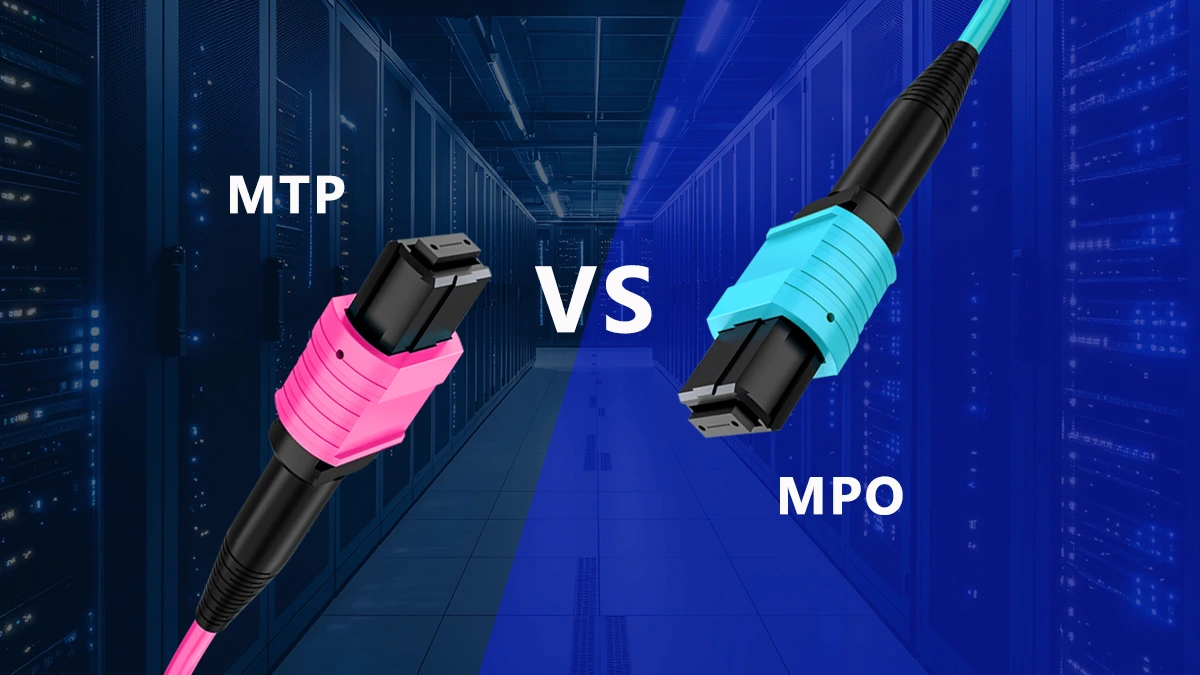
What Are MPO and MTP Cables?
MPO (Multi-Fiber Push-On) is a type of standardized multi-fiber connector that is intended for high-density fiber optic connections. By combining several optical fibers in one connector, an MPO cable reduces the quantity of cable and makes the process of installation in the data center easier.
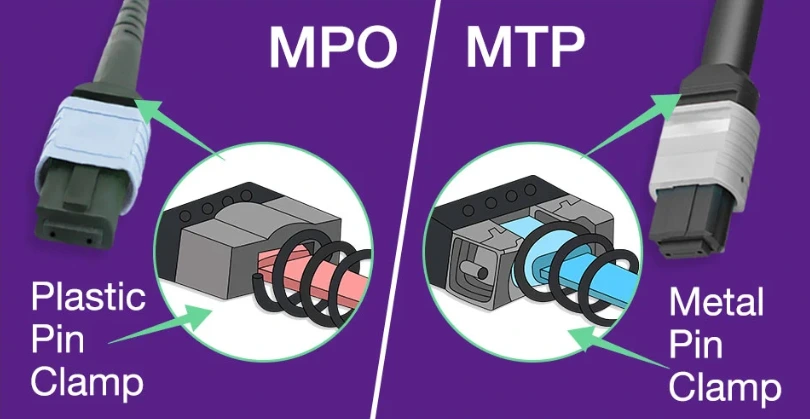
The structure of an MTP cable includes an MTP connector, which is the advanced version of the MPO standard. This cable has an upgraded mechanical design and fiber alignment in comparison with conventional MPO; thus, it is used in high-performance networks.
Depending on the application, an MTP cable can be of different types, including different numbers of optical fibers, cable structure, and modes of operation. The most common types of cable structures are MTP trunk cable, jumper cable, and harness cable.
MPO vs MTP Cable: What Are the Differences?
Although MPO and MTP cables share similar functions, the main difference lies in connector design and performance.
| Feature | MPO Cable | MTP Cable |
| Connector Technology | Standard multi-fiber connector | Enhanced MPO-based connector |
| Ferrule Design | Standard ferrule | Floating ferrule for improved alignment |
| Housing | Usually fixed | Removable housing for easier maintenance |
| Fiber Alignment | Standard precision | Higher alignment accuracy |
| Reliability | Suitable for general applications | Designed for demanding network environments |
The improved construction of MTP connectors is a factor in the better alignment of the fibers. As the design is characterized by the floating ferrule construction, the connector can always ensure good physical contact between the fibers.
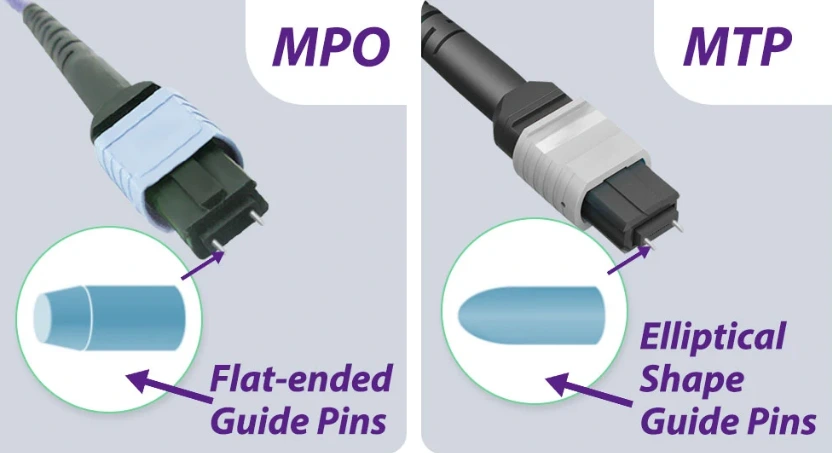
When compared to regular MPO solutions, the use of MTP cable offers some optical advantages and ensures greater reliability in the long term. This makes it an ideal choice for large data centers, cloud computing environments, and constantly developing networks.
Why Choose MTP Cable for Data Center Applications?
Modern data centers require cabling systems that can support higher bandwidth while maintaining efficient space utilization. A high-quality MTP cable helps simplify network architecture by combining multiple fiber channels into a compact connector design.
Key advantages include:
- High-density connectivity: Multiple fibers can be deployed through a single connector, reducing cable congestion.
- Simplified installation: Pre-terminated designs allow faster deployment compared with traditional fiber connections.
- Better scalability: MTP solutions support future network upgrades as bandwidth requirements increase.
- Reliable performance: Improved connector design helps maintain stable optical connections.
For applications requiring high-speed transmission and flexible network expansion, MTP-based cabling provides an efficient foundation for modern fiber infrastructures.
MTP Trunk Cable for High-Density Fiber Networks
Of various MTP systems, MTP trunk cables can be seen in use for making backbones of fiber panels, switches, and equipment cabinets.
The MTP trunk cable is a type of cable that can offer high-density fibers and help make cabling easy in the complicated environment of the data center. This system can help cut down installation time in comparison with a conventional fiber cabling system.
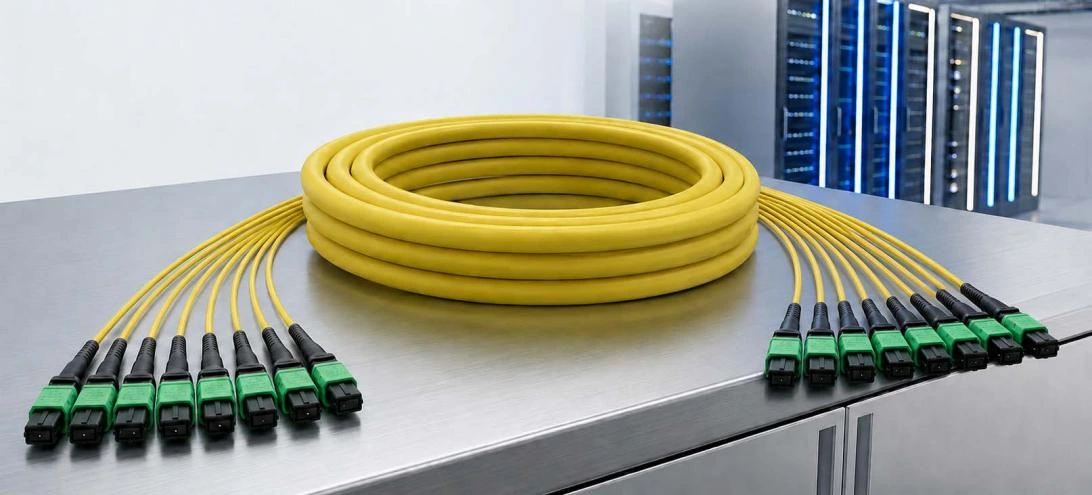
OMC provides various MTP-MTP trunk cable configurations to support different deployment requirements, including:
- 12F MTP-MTP Trunk Cable for standard high-density fiber connections.
- 24F MTP-MTP Trunk Cable for applications requiring higher fiber capacity.
- 24F-144F MTP-MTP Trunk Cable for large-scale data center backbone deployments.
These solutions are suitable for connecting network equipment, fiber distribution units, and server cabinets while supporting scalable and efficient cabling architectures.
How to Choose Between MPO and MTP Cables?
The selection of MPO vs MTP cables is dependent on the network requirement, performance level expected, and plans for expansion in the future.
While there are situations where an MPO cable would suffice to connect high-density fiber in a standard manner, for a more advanced data center where higher reliability and ease of maintenance are needed, MTP cables could be more suitable.
When selecting a fiber cabling solution, consider factors such as:
- Required transmission speed
- Fiber count and cable structure
- Network expansion plans
- Installation environment
Selecting the right cable type helps ensure stable performance and reduces future upgrade challenges.
Conclusion
Both MPO and MTP cables serve as efficient ways of implementing high-density fiber networking; however, MTP is superior with its higher connector efficiency and alignment, as well as higher reliability in contemporary data centers.
As an experienced provider of solutions for fiber optic networking, OMC is ready to offer a wide range of MTP to MTP trunk cables to fulfill your fiber optic cabling needs, regardless of whether you prefer 12F connections or 24F-144F trunk cables.
FAQ
How do MPO and MTP cables differ from each other?
MPO is a standard multi-fiber connector technology, whereas MTP is a modified type of MPO technology with enhanced connectivity and alignment.
Is an MTP cable compatible with MPO systems?
Yes. Since an MTP cable is built according to MPO specifications, an MTP cable will usually be compatible with MPO systems if the right parameters are met.
What is an MTP trunk cable utilized for?
The applications of MTP trunk cables are mostly related to backbone connections within data centers that connect fiber panels, switches, and network cabinets with dense fiber connections.
Which fiber counts can be found in MTP trunk cables?
Some of the common fiber counts in MTP trunk cables are 12-fiber, 24-fiber, and high-fiber-count cables like 48-fiber and 96-fiber.