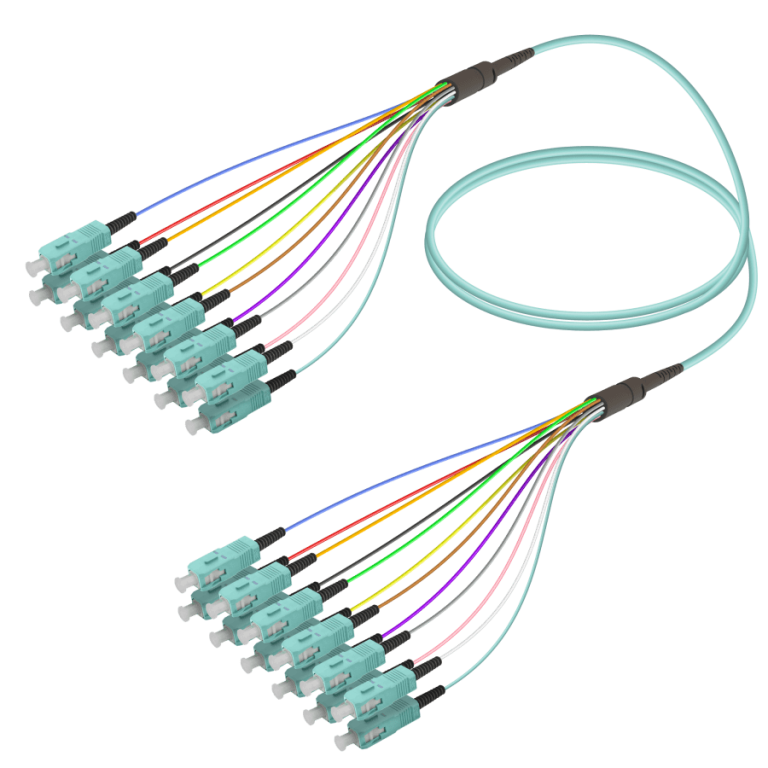
When planning the infrastructure for a backbone network on campus, an enterprise switch room, or a high-density server rack, one needs to take into consideration the compatibility between cable construction and the operation of optical transceivers. The comparison of simplex vs. duplex fiber enables engineers to prevent incompatibility of connectors, excess fiber strands, and expenses related to using transceivers in vain. Despite the fact that both types use the same glass technology—either single-mode (9/125 microns) or multimode (50/125 or 62.5/125 microns)—the difference lies in the number of strands and transmission direction.
1. What Is Simplex Fiber and How Does It Work?
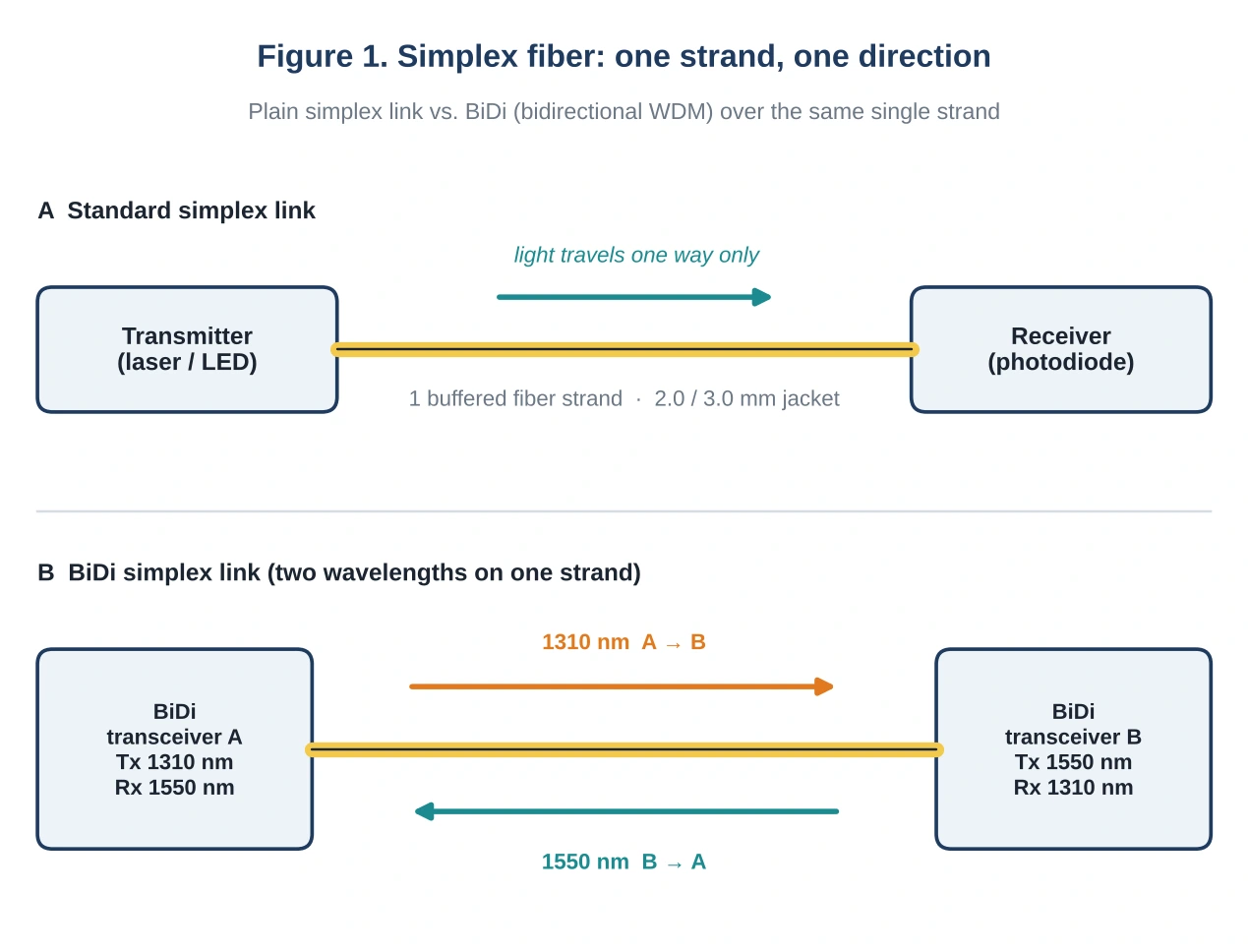
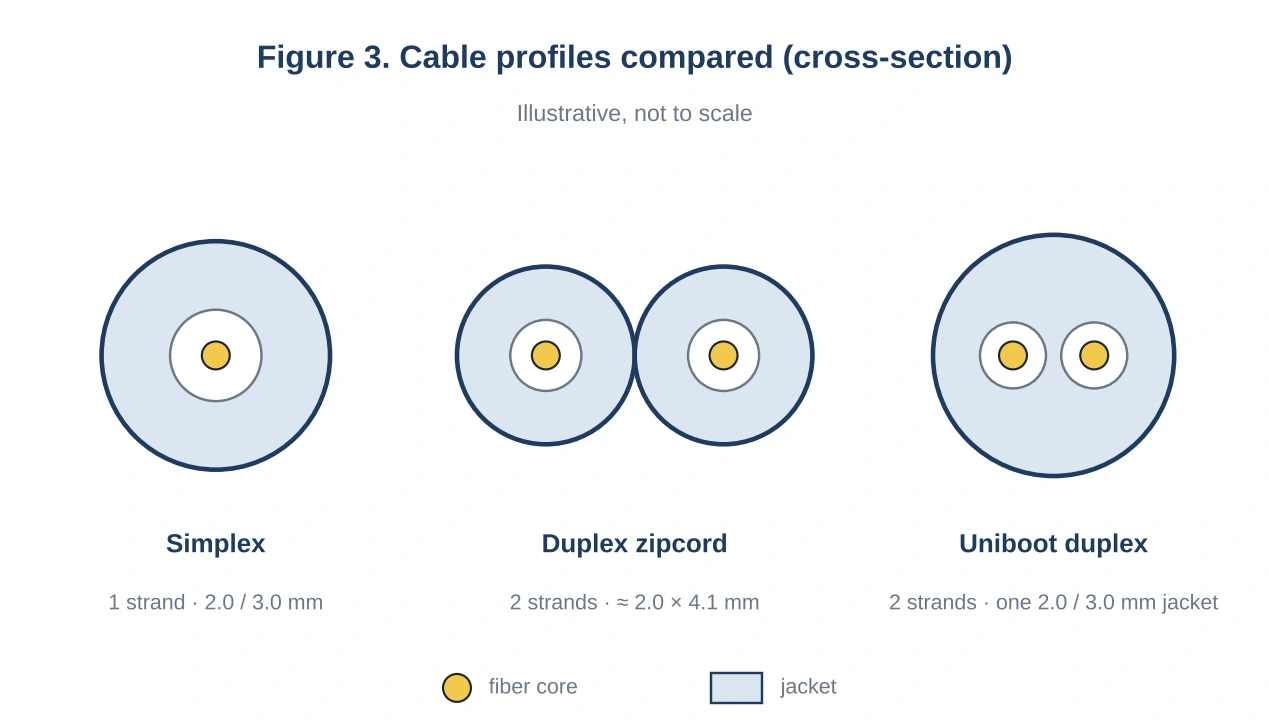
In the case of simplex fiber, there is only one buffered optical fiber strand enclosed within the outer jacket, which allows only the transmission of light in a one-way manner. For a typical point-to-point connection, the light beam will travel from the transmitter (Tx) at one end to the receiver (Rx) at the other end without any way of traveling back along the same strand. Typical outer diameters range between 2.0mm and 3.0 mm, and single-fiber LC, SC, or ST connectors are used.
Unidirectional Signaling and BiDi Wavelength Multiplexing
In simple simplex fiber connections, the optical signal is transmitted from the source (laser or LED) to the photodiode receiver. However, the optical transceiver now enables unidirectional signaling by utilizing bidirectional wavelength division multiplexing (BiDi), which allows transmitting and receiving different wavelengths along the same fiber strand – usually 1310nm and 1550nm using optical filters for isolation. When simplex ports are required for access line applications or sensor feeds, the field personnel use OMC-simplex single-mode patch cables for simplex applications. This prevents excessive pull tension on the conduit and unused spare fibers.
2. What Is Duplex Fiber and How Does It Work?
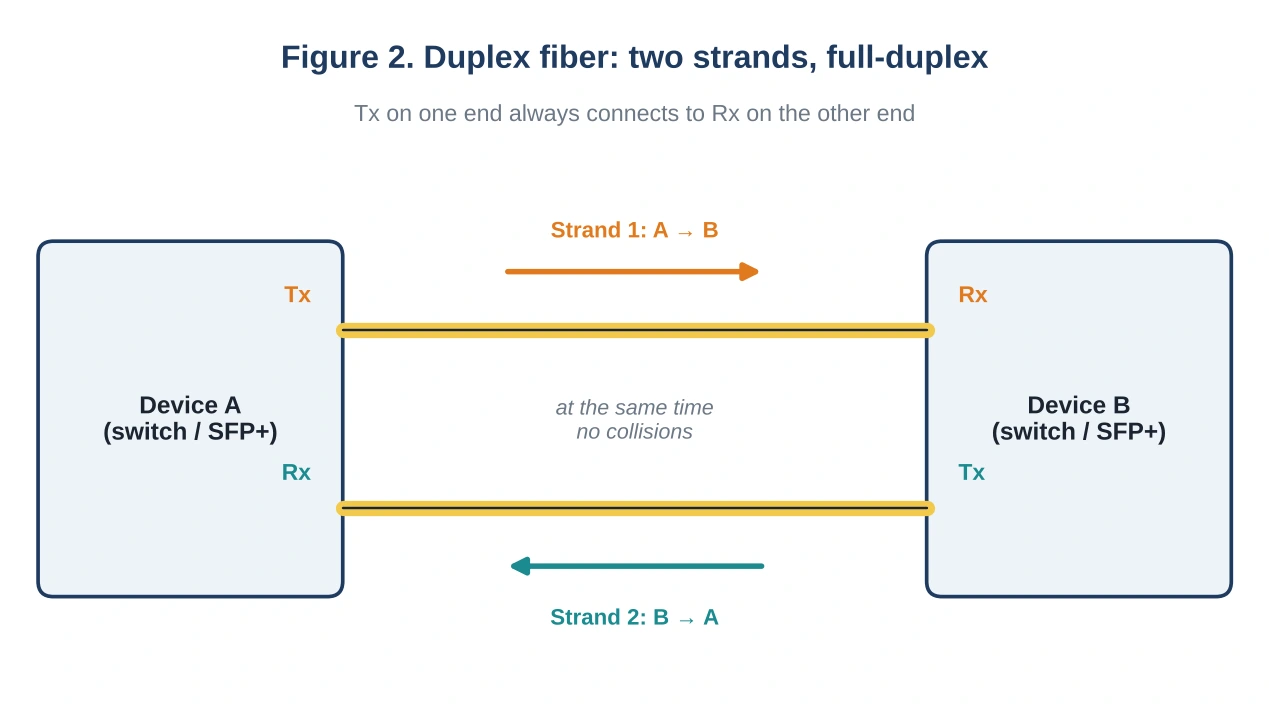
Duplex fiber combines two buffered optical fibers into one cable bundle in order to provide the ability to send information in two directions simultaneously. These fibers are usually located next to each other in a zipcord configuration or bundled in one round jacket, where one fiber is connected to Tx and the other one to Rx on each end of the cable. In terms of evaluating simplex vs. duplex fiber, it should be mentioned that there are two separate ways of sending and receiving information.
Half-Duplex and Full-Duplex Modes of Operation
There are two modes of duplex fiber transmission:
- Half-duplex: both ends have the opportunity to transmit and receive the information but only one of them sends information at once, when another one waits for the frame to finish.
- Full-duplex: one fiber transmits data from Tx, while another one receives it from Rx at exactly the same time without any collision and wait states. All 10G, 25G, 40G, and 100G SFP+ or QSFP28 optical transceivers use full-duplex mode of operation in order to maintain constant throughput.
When connecting patch panels to top-of-rack switches or storage arrays, installers often choose an OMC Uniboot LC-LC duplex fiber patch cable, which houses both optical strands inside a single round 2.0 mm or 3.0 mm jacket with a unified LC connector housing. Compared to traditional zipcord jumpers, this compact Uniboot design cuts cable bulk nearly in half for better rack airflow and allows quick polarity reversal without extra tools in high-density data center cabinets.
3. Simplex vs. Duplex Fiber: Key Differences
Comparing simplex vs. duplex fiber side by side clarifies how strand count affects physical footprint, transceiver compatibility, and upfront spend.
| Specification | Simplex Fiber | Duplex Fiber |
| Strand count | 1 optical fiber strand | 2 independent optical fiber strands |
| Signal direction | Unidirectional by default; bidirectional with BiDi optics | Simultaneous two-way (full-duplex) via separate Tx/Rx legs |
| Typical data rates | Often 100 Mbps to 10 Gbps (via BiDi optics) | Widely used at 1G, 10G, 25G, 40G, and 100G+ |
| Common connectors | Simplex LC, SC, FC, ST | Duplex LC clips, duplex SC, high-density trunks |
| Cable profile | Slimmer single jacket (often 2.0 mm or 3.0 mm) | Wider dual or zipcord profile (around 2.0 mm by 4.1 mm) |
| Per-link material cost | Lower fiber and connector count per run | Higher due to dual strands and dual-ferrule hardware |
| Typical use cases | Telemetry sensors, one-way feeds, fiber-to-the-home drops | Switch interconnects, SAN storage, enterprise backbones |
From a signal-integrity standpoint, keeping Tx and Rx on separate strands avoids back-reflections inside a shared fiber. On the other hand, running two-way traffic over a single strand saves cable volume while shifting extra cost onto specialized BiDi transceivers.
4. How to Choose the Right Fiber for Your Network: Simplex vs. Duplex Fiber
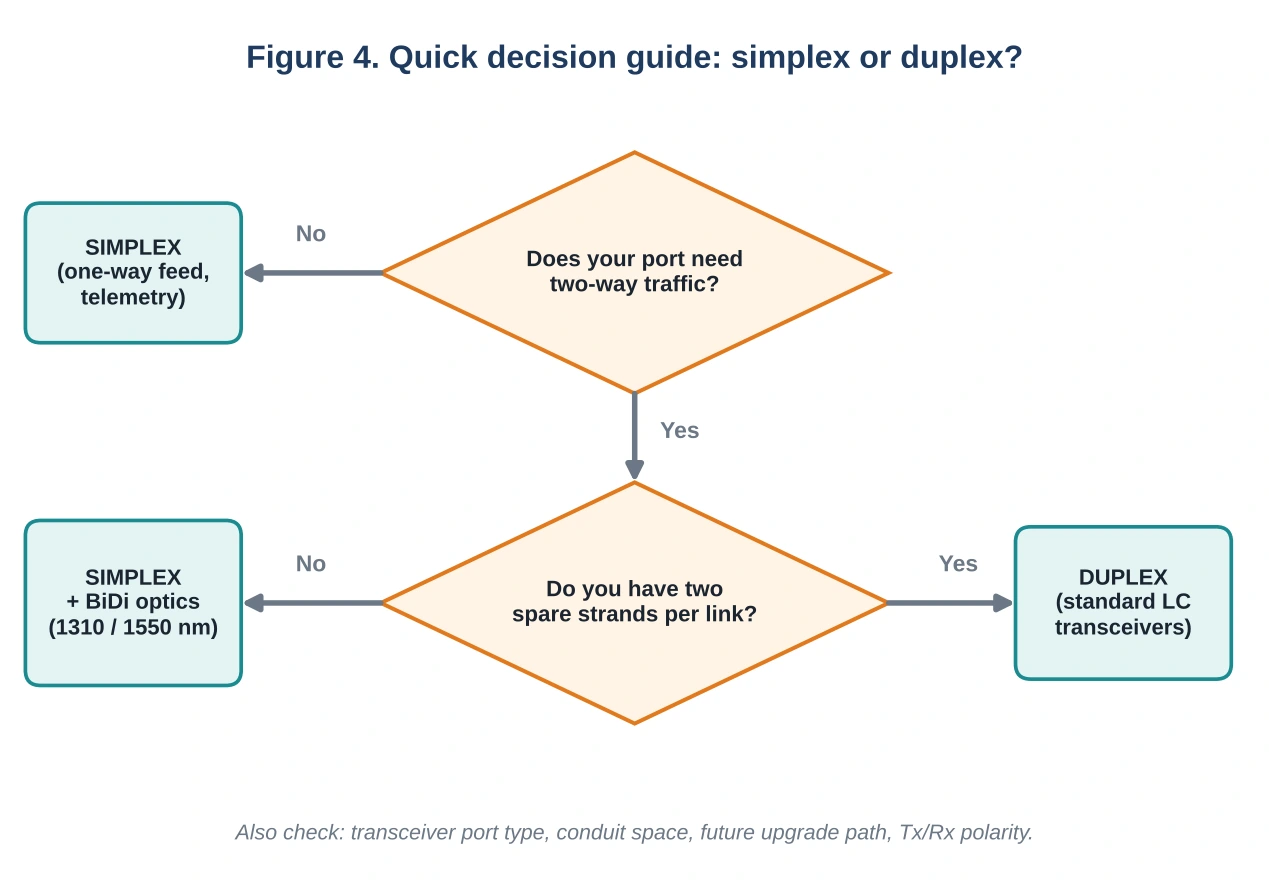
The selection of simplex vs. duplex fiber relies on the transceiver port specs, available conduit slots, and future upgrade possibilities, not just the cost difference between them.
Where Simplex Fiber Makes the Most Sense
- One-directional monitoring and telemetry: Sensors, meters, or broadcast distribution hubs sending data in one direction only don’t need bidirectional capabilities on the same fiber pair.
- Dense strand counts between buildings: In cases where the available underground duct has only one unused fiber per link, BiDi technology enables full-duplex communication using just one strand.
- Narrow passageways and tight bends: Single-fiber cables have a smaller bend radius – in many cases, it’s reduced to 30 mm bend-insensitive fiber – and are less bulky in confined spaces.
Where Duplex Fiber Makes the Most Sense
- Data centers and core switching: High-performance servers, switches, and storage equipment connections require full-duplex communication with consistent latency levels.
- Standard transceiver modules: The majority of mainstream SFP, SFP+, and SFP28 transceivers have dual-LC ports, making it easier to maintain inventory.
- Future upgrade potential: With a structured duplex run, you can use newer generations of transceivers in the future without replacing cable plant infrastructure.
5. Conclusion
Determining whether simplex vs duplex fiber is more suitable for a given network design is all about striking the balance between the economical use of single strands and dedicated duplex capacity. In case of one-directional data transfer, dense strand counts, or BiDi communications, simplex fiber is the best choice. In case of building enterprise network fabrics and fast server interconnects, the requirement for two-way traffic at a time implies the use of duplex fiber – just double-check Tx/Rx polarity and wavelengths.
If you have any inquiries concerning fiber cable configurations, transceiver compatibility, and special patch cords, feel free to get in touch with us any time – our OMC team is always ready to provide you with professional recommendations and quotes.