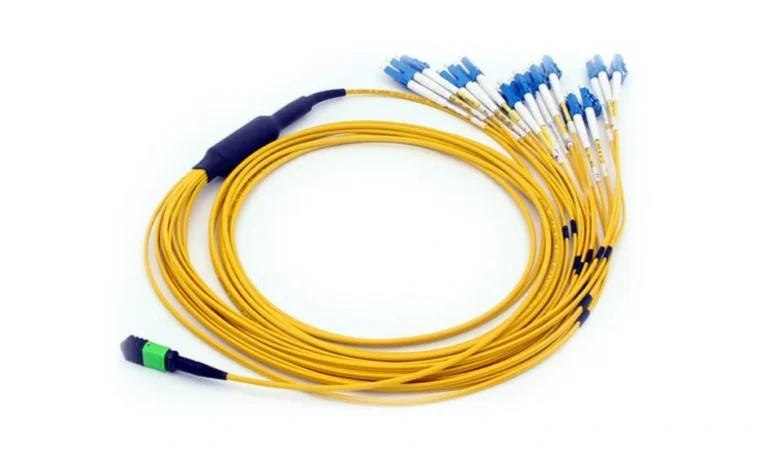
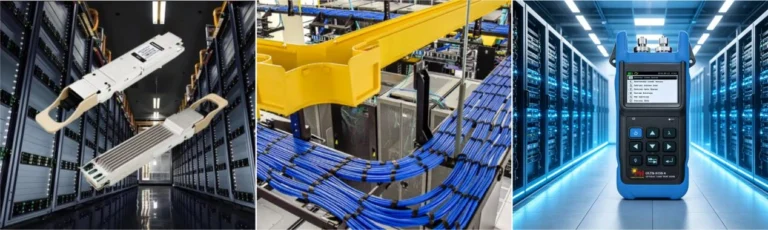
The advancement of the technological landscape means that the usage of MPO fanout cables is indispensable nowadays for establishing high-density connectivity. With the development of cloud technologies, artificial intelligence, and data storage services, there is an increasing demand for network bandwidth. Conventional cabling systems cannot satisfy the requirement for high-density and high-performance connections. Against such a backdrop, MPO fanout cables, by effectively distributing multi-core fibers, offer highly reliable options of connectivity for different devices.
What is MPO Fanout Cable?
An MPO fanout cable, also referred to as an MPO breakout cable or MPO-LC Harness cable, is a type of fiber optic cable that changes high-density MPO connections to individual single-fiber connections, such as LC and SC connections. The cable allows for splitting the transmission from multi-core optical fibers into several ports and connecting the devices through those ports. Usually, MPO connections are used for connecting to trunking cables or modules with high density, whereas the LC/SC ports will connect to switches, servers, or patch panels. It provides higher wiring density, reduced data center footprint, and lower costs for installation and maintenance.
Common Types of MPO Fanout Cables
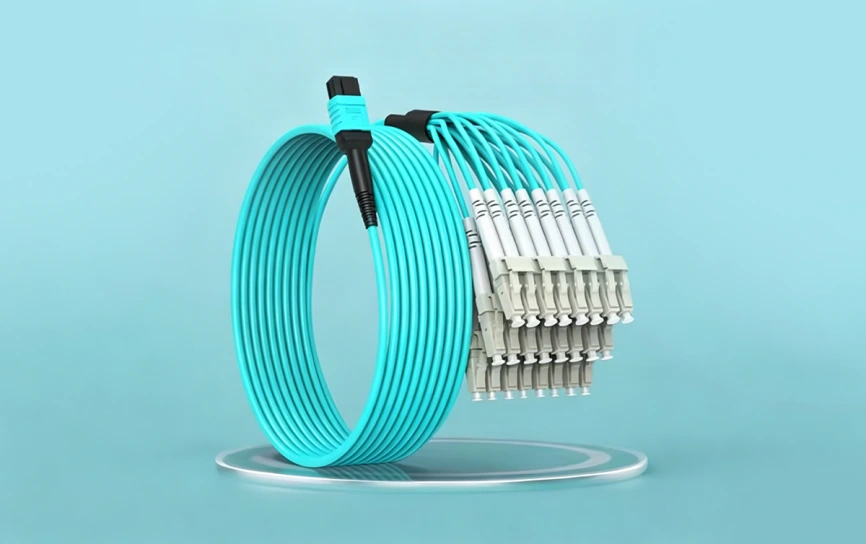
Based on structure, application scenarios, and fiber types, MPO fanout cables on the market can be classified into several categories:
1. By Connector Type
- MPO-LC Fanout Cable
This type is mostly used to fan out an MPO interface to several LC connectors. The advantages include its compactness, density, ease of maintenance because of the plug-and-play feature, and the ability to use it with modern data centers that need to make a conversion between 40G and 10G, 100G and 25G, etc.
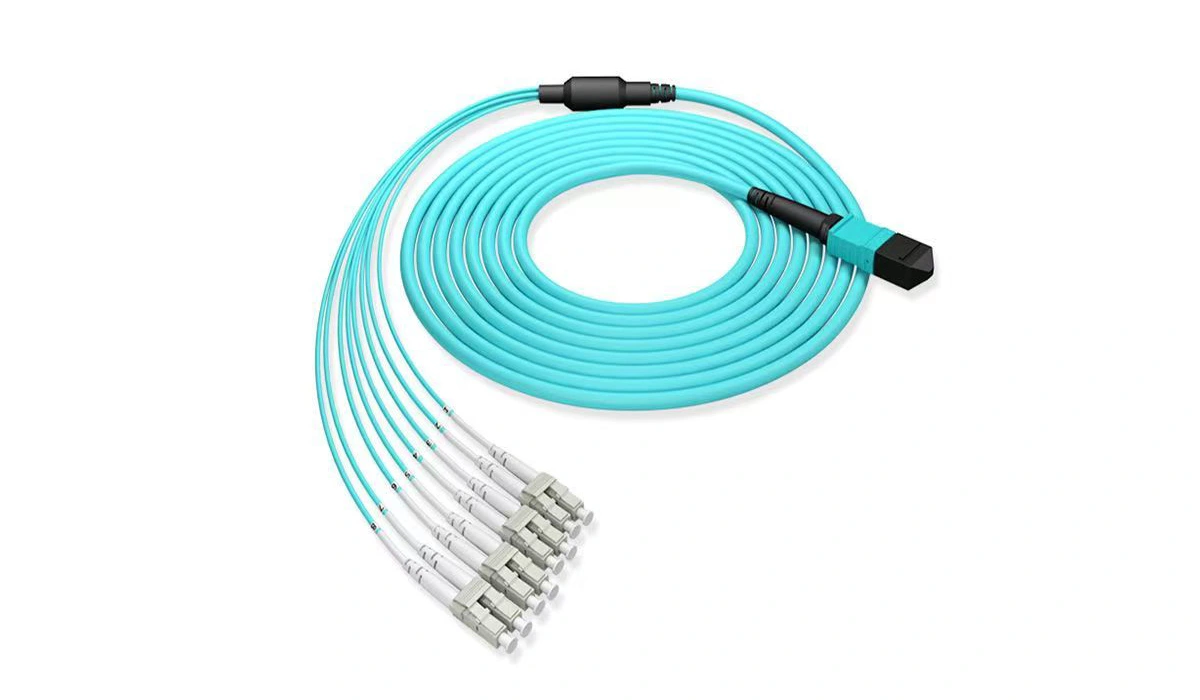
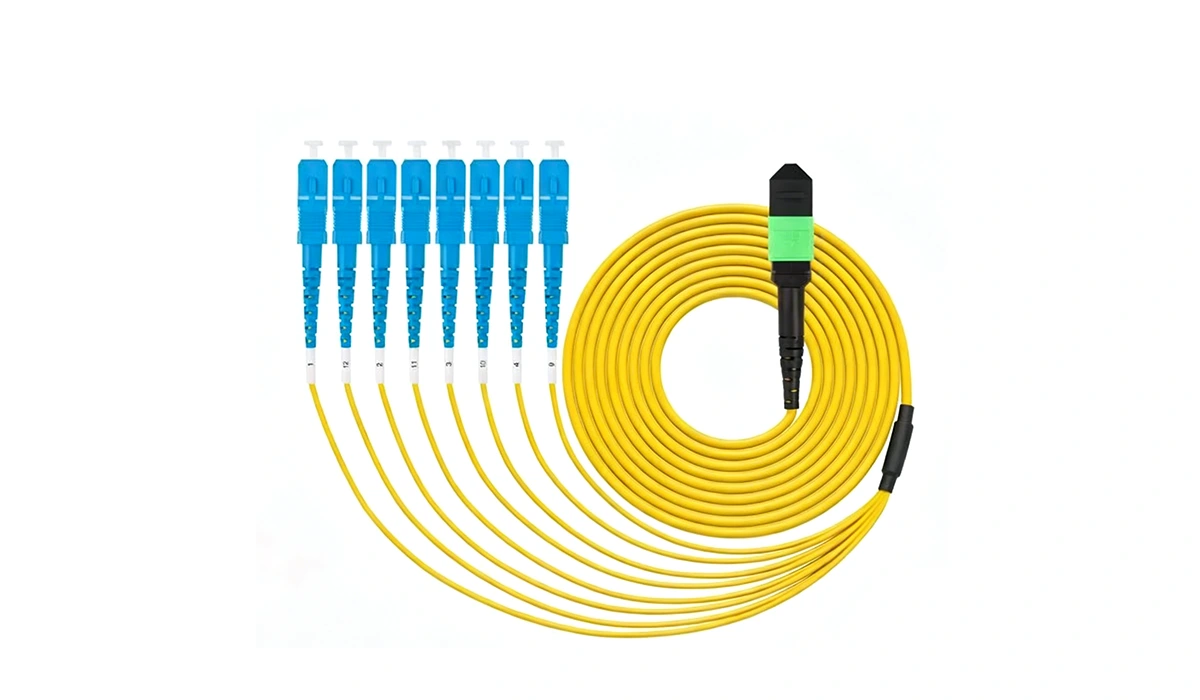
- MPO-SC Fanout Cable
This type splits MPO into SC connectors. SC connectors are larger and more robust, making them ideal for traditional networks or upgrading older data centers that need compatibility with existing systems.
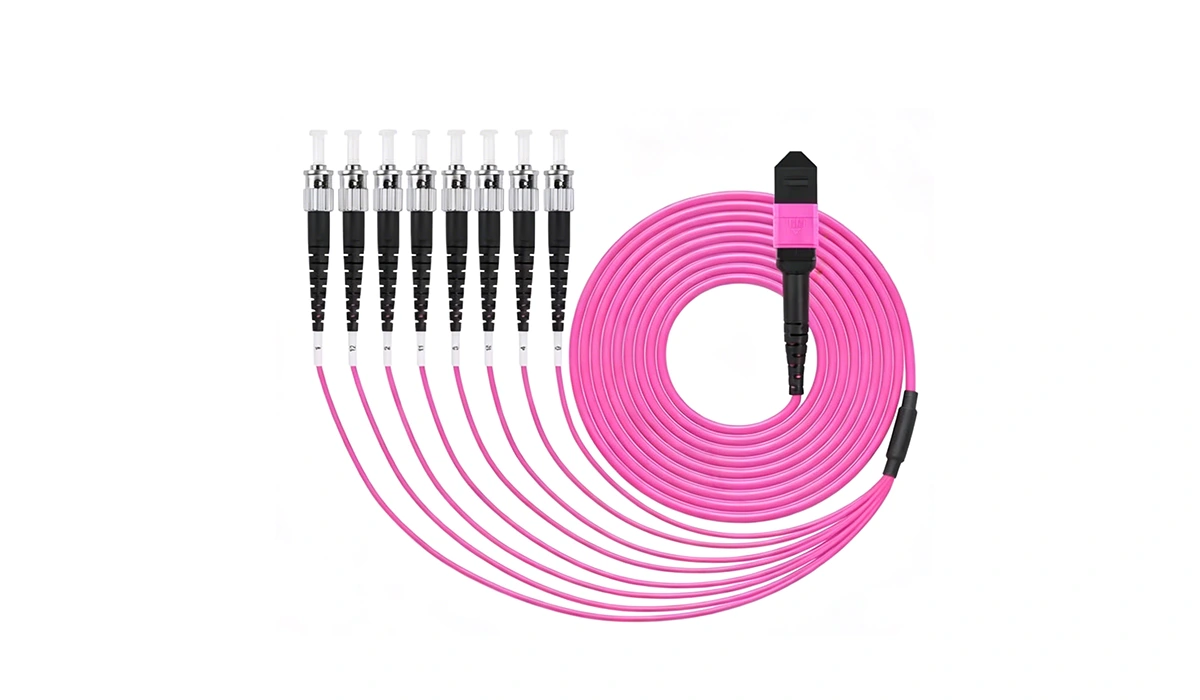
- MPO-ST Fanout Cable
An ST connector offers shock protection by its bayonet design, making it perfect for use in industrial or outdoor environments. Although uncommon in data centers, it can be used in some situations.
2. By Fiber Mode
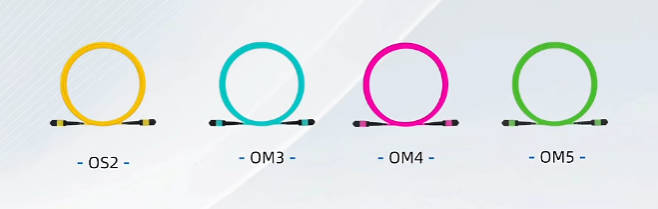
- Single Mode MPO Fanout Cable
Single-mode fiber is used for long-distance transmission, offering low signal attenuation and dispersion. It’s ideal for backbone and inter-data center connections, maintaining stable performance over distances of 10 km or more. - Multimode MPO Fanout Cable
Multimode fibers are cheap for short-range, high-speed transmissions in data centers. Such fibers support high bandwidth with OM3, OM4, and OM5 technologies, where OM5 technology allows wavelength division multiplexing, enhancing data transfer capability.
3. By Core Count
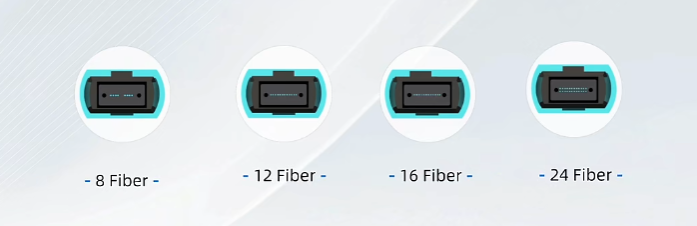
- 8-Core MPO Fanout Cable
An 8-core fanout cable is used in 40G network communication, which contains 4 transmitting and 4 receiving cores. An eight-core MPO cable offers optimization in network infrastructure by reducing unused fibers compared to 12-core MPO fanout cables. - 12-Core MPO Fanout Cable
The 12-core MPO fanout cable is the most commonly used standard configuration. This is due to the fact that it provides high levels of compatibility, making it easy to apply this design everywhere. - 24-Core MPO Fanout Cable
This design can be used in environments that need high fiber density and throughput. The 24-core configuration can provide much higher speeds, such as 100G or 400G networks, increasing fiber channels per cable dramatically while providing greater network throughput.
4. By Polarity
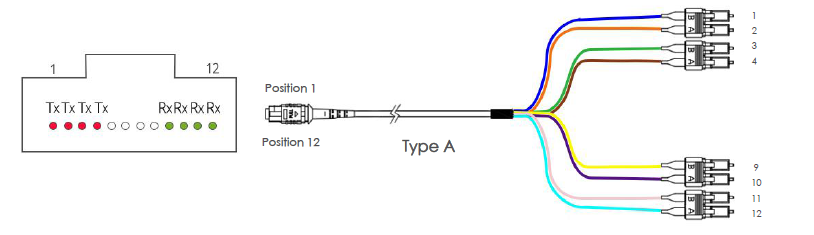
Polarity is one of the most important criteria because it defines whether the connection between the transmitter and receiver was established properly. Despite having a physically correct connection, poor polarity will not enable proper signaling.
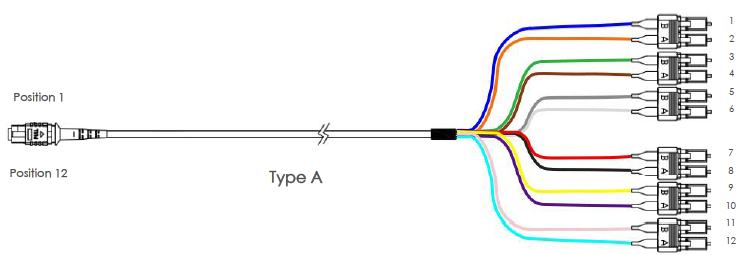
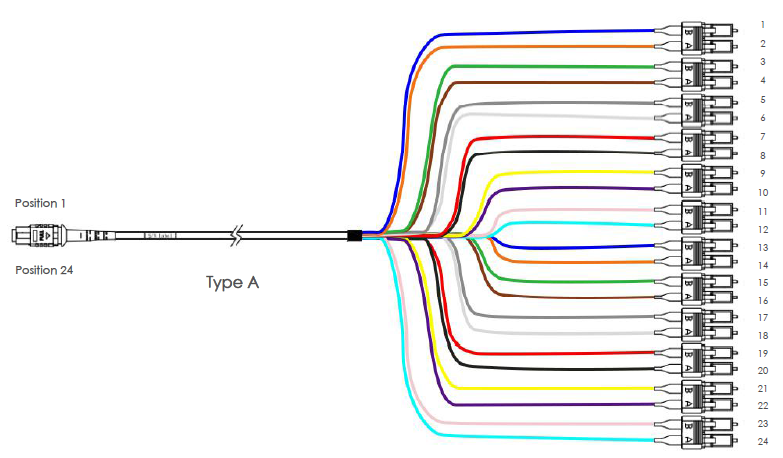
- Type A (Straight Through)
The fibers are connected in the same order, suitable for specific wiring schemes, but may require additional connectors to achieve correct signal flow.
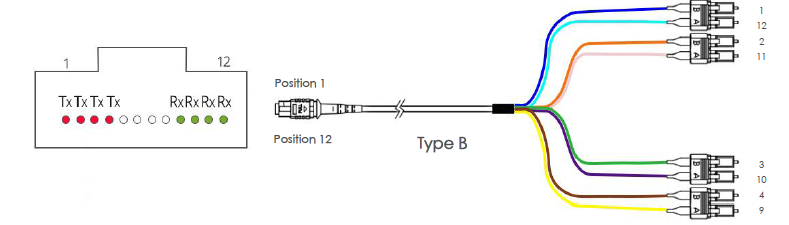
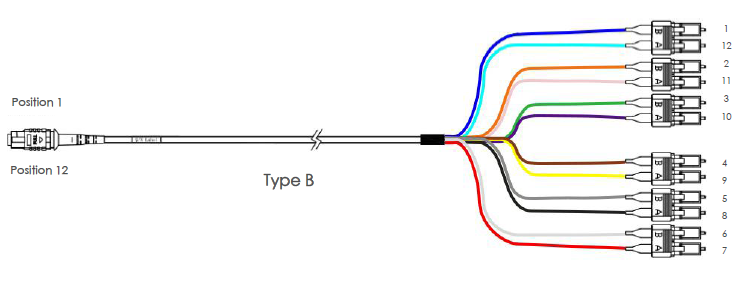
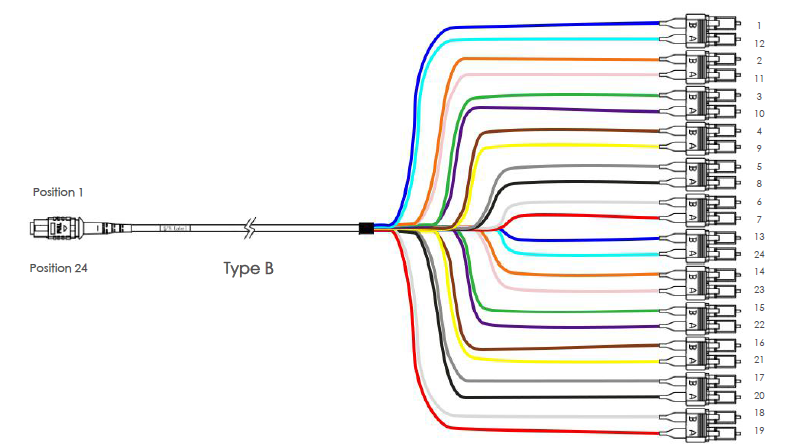
- Type B (Reverse)
The fiber order is completely reversed, typically used for direct matching between the sender and receiver, and is the most common polarity used in data centers.
5. By Structure Type
- Ribbon Structure
Ribbon fiber arranges multiple fibers in a parallel structure, offering high density and easy management. This structure is ideal for large-scale data center cabling, significantly improving cabling efficiency while minimizing space usage. - Loose Tube Structure
In loose tube structures, fibers are relatively independent, offering better flexibility and tensile strength. This type is suitable for complex environments or wiring that may need frequent adjustments. It is advantageous in specific applications that require more robust fibers. - Custom Fanout Length
Many MPO fanout cables provide customization in length that can be done as per the requirements of the cabinet and equipment. Customizing the cable length will result in reduced bundling of cables and better looks and performance as well.
How to Choose the Right MPO Fanout Cable?
When selecting an MPO fanout cable, you need to consider the following key factors:
- Network Speed: Choose the appropriate fiber type based on your required network speed. For example, 10G, 40G, 100G, or higher-speed networks require different fiber specifications and core counts. Ensure the chosen fiber meets both your current and future bandwidth needs.
- Transmission Distance: Transmission distance determines whether you need single-mode fiber or multimode fiber. Single-mode fiber is for long-distance transmission (e.g., across cities or backbone networks), while multimode fiber is better for short-distance transmission (such as internal data center connections). Choose based on actual usage to avoid unnecessary cost.
- Device Interface Type: Ensure the connector type of the MPO fanout cable (such as LC, SC, etc.) is compatible with the ports on your existing equipment. Different devices may require different connectors, so make sure to confirm the connector type your equipment supports before purchasing.
- Fiber Core Count: Fiber core count should be determined based on network topology and bandwidth requirements. Higher bandwidth typically uses more fiber cores (e.g., 12-core, 24-core), especially in applications that need to support multiple data channels simultaneously. Based on the number of device ports and future expansion requirements, choose the appropriate fiber core count.
- Polarity Matching: Ensure the polarity (such as Type A, Type B, or Type C) of the fiber matches the overall wiring system. This will ensure proper signal transmission between the sending and receiving ends.
Conclusion
Many kinds of MPO fanout cable can be found in today’s market, and they are distinguishable based on their connector type, fiber type, core number, polarity, and construction. It is necessary to know about each kind of these cables to make an appropriate decision.
For those planning or upgrading networks, selecting the right MPO fanout cable enhances network performance, reduces maintenance costs, and boosts system stability. OMC GROUP offers high-quality solutions tailored to your needs. If you have any questions or need further assistance, feel free to contact us — we’re here to help!