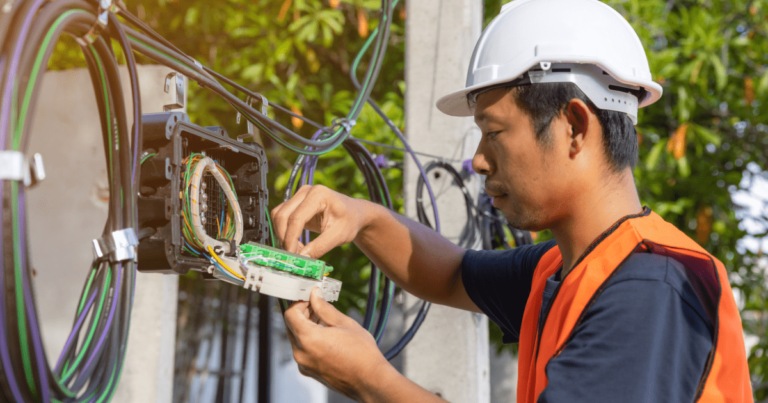
Aerial fiber optic cable is engineered to hang securely in outdoor environments, supporting stable signal transmission despite wind, temperature changes, and mechanical stress. While the general purpose is the same as other optical cables—transmitting light through fiber cores—its materials, structure, and reinforcement systems are designed specifically for elevated installation.
Core Aerial Cabling Solutions
When planners say “aerial cabling,” they usually mean one of several proven approaches. Each solution has trade-offs in cost, mechanical strength, and installation complexity.
1. Figure-8 and Messenger-Supported Cables
- What it is: A fiber cable attached to a steel messenger (appearing as an “8” cross-section).
- Strengths: Strong mechanical support, simple splicing workflow, widely used on shared utility pole networks.
- When to use: Municipal pole networks or shared-utility routes requiring robust tensile support.
2. Lash-Up Systems (Lashing to a Messenger)
- What it is: A lightweight fiber cable is lashed to a pre-installed messenger wire using a lashing machine.
- Strengths: Cost-effective for dense short spans and for adding capacity to an existing messenger.
- When to use: Urban blocks and suburban streets where messenger infrastructure already exists.
3. Self-Supporting FTTH Drop Cables
- What it is: Small-diameter, self-supporting drop cables for the final connection from pole to building or terminal box.
- Strengths: Easy to install, low visual impact, suitable for direct attachment without heavy hardware.
- When to use: Last-mile home connections, small businesses, or multi-dwelling units with short pole runs.
Practical Design Considerations for Aerial Cabling
Choosing one of the aerial cabling solutions above requires matching network goals with environmental realities. Key engineering points include:
- Span length and sag: Longer spans need stronger reinforcing members; calculate expected sag to avoid ground or foliage contact.
- Wind and ice loading: In cold or coastal regions account for ice accretion and gusts—select thicker strength members or ice-rated sheaths.
- Proximity to power lines: If running near energized lines, prioritize nonconductive ADSS or follow precise clearance rules.
- UV and environmental resistance: Outdoor jackets (PE or UV-stable LSZH) extend service life under sun and rain.
- Serviceability and inspection: Aerial routes are easier to inspect visually; design for accessible splice points and safe climb zones.
- Future capacity: Consider spare fibers or microducts when budgets allow; retrofitting is more expensive than initial overcapacity.
Installation Practices That Improve Reliability
Good materials alone don’t guarantee success. These work practices reduce failures and maintenance costs for aerial cabling:
- Use rated anchors, dead-ends, and strain-relief hardware sized for expected loads.
- Maintain consistent tension during installation; document pre-tension specs for future work.
- Route clearances: keep cable clear of tree branches and avoid areas prone to vehicular contact.
- Thermal expansion: allow for movement in fixtures where temperature swings are large.
OMC’s Recommended Products:2x5mm 1-Core Self-Supporting Aerial FTTH Drop Cable Patch Cord

For the “last cable” in FTTH deployments, small, robust drop cables simplify installation and reduce time on poles. The 2x5mm 1-core Self-supporting Aerial FTTH Drop Cable Patch Cord combines an easily accessible fiber with mechanical strength suited for short aerial spans.
Key features:
- Design: One optical fiber centered, flanked by two parallel FRP or KFRP strength members.
- Sheath: LSZH outer jacket for fire safety and environmental protection.
- Use cases: Direct connection between face plates, terminal boxes, and ONUs; ideal as the final run to homes.
- Benefits: Simple termination, low profile, and compatibility with standard FTTH access hardware.
- Customization: Connector types can be specified to fit existing equipment or installer preference.
This product type is especially practical for dense access networks where installers need a compact, self-supporting cable to make quick, clean drops to residences or small businesses
How to Select an Aerial Cabling Strategy
- Map the route and measure spans. Long spans push you toward ADSS or OPGW; short spans allow lashing or self-supporting drops.
- Survey environmental loads. Wind, ice, and exposure determine strength member and sheath choices.
- Check electrical proximity. Near power lines prefer dielectric designs.
- Define maintenance access. If frequent repairs are expected, favor routes that are easy to inspect.
- Choose suppliers with field support. A trusted vendor can help adjust specs to local conditions—companies such as OMC are one example of vendors that offer both product and technical support.
Conclusion
Aerial cabling offers flexible, cost-effective routes for expanding fiber networks when trenching is impractical. Match route conditions, mechanical loads, and service goals to pick the right approach, and include spare capacity where possible to avoid costly rework later.