There exists a variety of types of fiber connectors, and each of them has its own advantages and disadvantages. Fiber connectors are the means by which optical fibers are joined in a quick and efficient manner, signal loss is minimized, and the integrity of the transmitted data is preserved. Today, through this paper, we will find out about the different types of fiber connectors, their pros and cons, and a common fiber optical connector parameter comparison table.
 Why is it so Important to choose the Right Connector
The selection of a type of fiber connector, among the various types of fiber connectors, is determined by the kind of fibers utilized (single-mode or multimode fibers), the amount of insertion loss that can be tolerated, and the network’s scalability. As a result, the use of an incorrect connector type can cause the weakening of the signal, an increase in error rates, and, consequently, an increase in the system’s downtime.
Popular Fiber Connectors
Here is an overview of the most popular types of fiber connectors, their disadvantages, functionality, and usage:
(1)SC Connector (Subscriber Connector)
Push-pull, square-bodied connector featuring a snap-in coupling, very popular for use in data or communications networks.

Advantages:
- Low insertion loss
- Repeatability
- Ease of removal
Disadvantages:
- Larger size compared to newer connectors
- Not ideal for high-density applications
Applications:
- CATV
- LANs
- FTTH networks
(2)LC Connector (Lucent Connector)
The LC connector is a small form-factor connector with a latch mechanism. Its compact size makes it suitable for high-density patch panels and modern data centers.

Advantages:
- High-density friendliness
- Low insertion loss
- Strong back reflection
- Supports both single- and multi-mode fiber
Disadvantages:
- It requires careful handling because of its small size
- It is slightly costlier than SC
Applications:
- Data centers
- Gigabit Ethernet and 10G networks
- High-performance computing networks
(3)ST Connector (Straight-Tip)
types of fiber connectors that are commonly used for multi-mode fiber communication systems, and are simple to insert and rotate into position.
Advantages:
- Robust and dependable operations in challenging conditions
- Fast connect and disconnect actions
Disadvantages:
- Bulky
- Not suitable for high-density configurations
- Less often encountered on new networks
Applications:
- Campus networks
- Fiber networks in industry
- Legacy telecommunication networks
(4)MPO/MTP Connector (Multi-F)
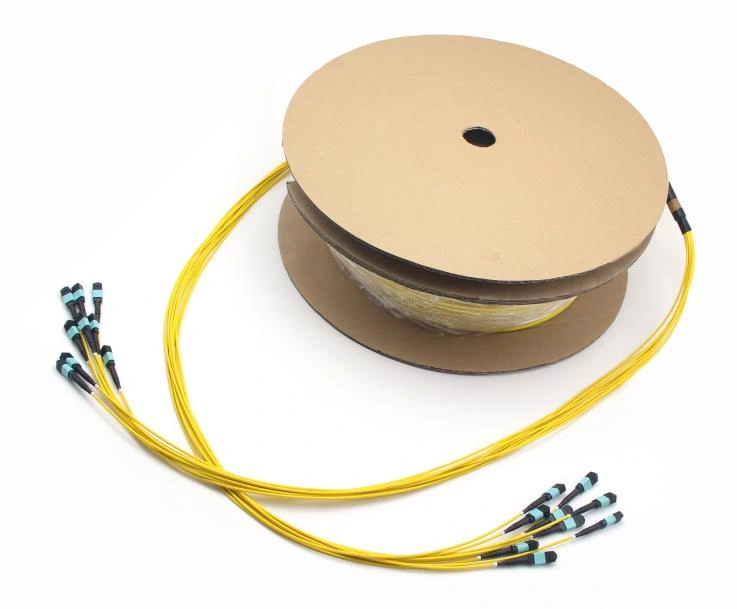
The MPO or MTP connector is designed for multi-fiber applications, allowing multiple fibers to be connected simultaneously. This connector is commonly used in high-speed data transmission and parallel optics systems.

Advantages:
- Highly dense fiber deployment
- Facilitates faster installation of many fibers
- Excellent for 40G, 100G, and above
Disadvantages:
- Cost and complexity are greater
- Needs accurate alignment and cleaning
- Not suited for small network applications
Typical applications:
- Data centers with high bandwidth demand
- Parallel optical computing
- Specialized Fiber Connectors
Apart from the general types, there are connectors designed for rugged environments or special use.
(5)FC Connector (Ferrule Connector)
The FC connector uses a screw-on mechanism and a ceramic ferrule, providing stable and low-loss connections. It is ideal for precision applications.

Advantages:
- Very low insertion loss
- Vibration-stable
- Temperature-stable
- Long-lasting
Disadvantages:
- Installation can be time-consuming
- Less flexible for frequent reconnections
Typical uses:
- Test and measurement equipment
- Military and space applications
- High-precision optics
(6)MTRJ Connector (Mechanical Transfer Registered Jack)
A small duplex connector where two fibers are placed side by side is commonly categorized among the types of fiber connectors.

Advantages:
- Space-efficient for dense connection
- Easy connection and disconnection
- Supports duplex data transfer
Disadvantages:
- Insertion loss is higher than in LC
Applications:
- LANs
- Patch panels
- Telecom cabinets
Common types of fiber connectors Parameter Comparison Table
This table presents a parameter-based comparison of common types of fiber connectors. It focuses on quantitative aspects such as fiber compatibility and transmission capacity. The data supports quick technical reference during connector selection
| Connector Type | Fiber Type Compatibility | Typical Usage Capacity / Speed |
| SC | Single-mode & Multi-mode | Up to 10 Gbps |
| LC | Single-mode & Multi-mode | Up to 40 Gbps |
| ST | Multi-mode | Up to 1 Gbps |
| MPO/MTP | Single-mode & Multi-mode | 40–400 Gbps (multi-fiber) |
| FC | Single-mode | Up to 10 Gbps |
| MTRJ | Multi-mode | Up to 10 Gbps |
The comparison shows clear differences in performance across types of fiber connectors. High-density connectors generally support higher transmission capacity, while standard connectors offer cost advantages. These parameters help align connector choices with network design requirements.
How to Choose the Right Types of Fiber Connectors?
- SC and LC are known for reliability purposes and reasonable density, with a preference for LC when a higher density is required.ST range continues to be viable largely for backward compatibility or industrial use.
- MPO/MTP is very good in high-bandwidth data center applications, but has to be handled carefully.
- FC performs well when accuracy and vibration resistance are of the highest importance.
- MTRJ is smaller and supports duplex, but is not in general use now.
The choice of a connector, then, involves the consideration of types of fiber connectors, allowable loss values, sizes, cost, and environmental factors.
Conclusion
Choosing the right types of fiber connectors is essential for building reliable and efficient fiber networks. A balanced evaluation of technical characteristics, system requirements, and overall network performance, considering both design parameters and practical metrics, helps ensure stable operation and future expansion. However, OMC can also give expert advice and customized results. If you’re doubtful which type is best suited for your operation, please feel free to contact us.