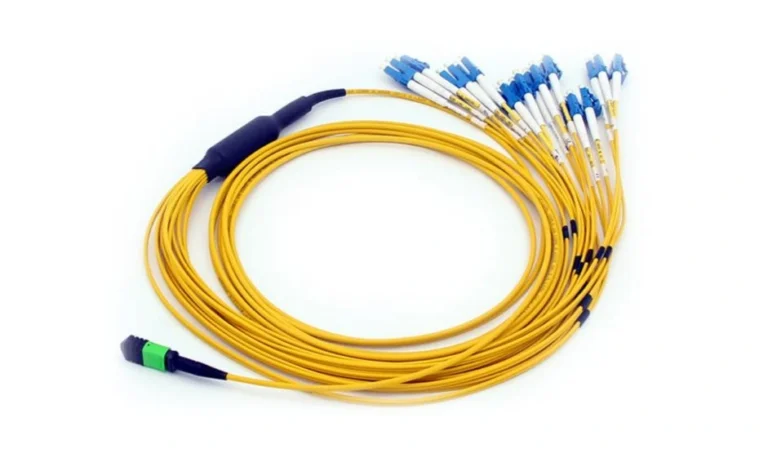
As data centers, cloud computing, and fast networks keep growing, there is more and more need for fiber optic links. Network infrastructure must support more connections within limited rack space while maintaining reliable signal transmission and organized cable layouts. This creates new challenges for traditional fiber cabling, especially in facilities with a large number of servers and switches.
However, how can we solve the existing problems using an adequate cabling infrastructure? Here comes another promising cabling solution – MPO Fiber Cable. Multi-fiber connection allows reducing the density of connections, improving the installation process, and enabling network expansions. Why is MPO Fiber Cable becoming more popular in modern network environments? There are five reasons that make it effective in practice.
1. MPO Fiber Cable Offers High Fiber Density in Limited Space
Space in the data center is always a valuable commodity. The increase in the number of servers, switches, and storage results in increasing occupancy of rack space by the equipment and the connecting cables. Single fiber connections are likely to require many individual connectors, which results in crowding of the cable paths.
MPO connectors help to overcome this problem by consolidating multiple optical fibers in one connector. Typical variants are 8-fiber, 12-fiber, 16-fiber, and 24-fiber arrangements, which allow handling multiple connections through one connection interface.
Main practical advantages of MPO connectors are:
- Reduced connector space: multiple fibers are consolidated in one connector instead of individual connection points;
- Better rack utilization: more fiber connections can be placed in limited panel space;
- Better backbone connection: multi-fiber cables can help to decrease the number of individual cables between distribution areas.
Thus, MPO Fiber Cable is an efficient way to better utilize the available space and leave more space for installation of the equipment and further network development.
2. MPO Fiber Cable Speeds Up the Installation and Deployment
Installation of the fiber infrastructure in the large data center may require hundreds or even thousands of connection points. Traditionally, termination of the field fibers requires performing many individual operations like fiber preparation, connector installation, and testing. All these operations increase the burden of installation work.
Typically, MPO Fiber Cables use factory-terminated connectors that allow connecting pre-assembled cable ends to the corresponding modules, panels, or equipment interfaces. This helps to reduce the termination work in the field.
The main advantages of MPO connectors in terms of installation are:
- Less field termination:factory-assembled connectors reduce the need for extensive work with fibers in the field;
- Fewer connection operations: many fibers can be connected through a single connection interface;
- Improved connection consistency: factory checks help to ensure proper connector assembly and optical performance.
The real installation time depends on the cable length, routing scheme, connector polarity, and other factors. However, appropriate planning of installation is needed to avoid mismatching of the ports and additional rework.
For instance, OMCFTTH provides 48F MPO-MPO Trunk Cable, featuring MPO/MTP connectors on both sides of the cable. Such trunk cables are used to connect the fiber distribution panels, modules, and breakout assemblies. The 48-fiber configuration makes the cable suitable for backbone connections in the data center, where many optical channels should be organized.
3. MPO Fiber Cable Simplifies Cable Management
With the increasing number of fiber connections, the management of the cabling environment becomes more complicated. Too many individual patch cords may overlap, cross rack paths, and hinder access to the equipment. Moreover, poor cable organization complicates the troubleshooting process.
Multi-fiber connection helps to consolidate many individual cable runs. Instead of managing many individual connections in the backbone path, technicians may use consolidated trunk cables to organize connections between the distribution points.
Main improvements in terms of cable management are:
- Less cable crowding: multiple fibers are consolidated in a single cable assembly;
- Improved identification: labels, color coding, and port numbering can help to trace individual connections.
- Simpler maintenance: An organized layout helps technicians locate connection points and perform routine inspections.
However, cable management involves more than reducing cable quantities. Technicians must also maintain the recommended bend radius, avoid excessive pulling tension, and secure cables without compressing them.
Utilizing appropriate cable trays, routing guides, and distribution panels in conjunction with MPO connectors makes it possible to preserve optical performance and facilitate maintenance.
4. MPO Fiber Cable Facilitates High-Speed Network Connectivity
With the rapid evolution of cloud-based services, virtualization technologies, and large-scale computing applications, modern data centers are supposed to process increasing amounts of data traffic. In order to cope with it, cabling infrastructure is required to be capable of facilitating the transmission architecture demanded by optical transceivers.
MPO connectors are popular in parallel optical transmission systems in which multiple fibers transmit data through their individual optical channels. Depending on transceiver design and fiber configuration, MPO connectors can facilitate networks of 40G, 100G, or 400G.
The significance of MPO connectors in terms of high-speed connectivity includes:
- Parallel transmission: Multiple fibers transmit data through individual optical channels.
- Compatibility of MPO connections with compatible optical transceivers and distribution modules.
- Flexibility of network architecture: Trunk cables and breakout assemblies facilitate different equipment interfaces.
It is necessary to emphasize that an MPO connector alone cannot ensure the specified transmission speed. It is affected by fiber type, specifications of the transceiver, transmission distance, insertion loss, and equipment compatibility.
Single-mode and multimode fibers have different uses in terms of transmission, and selecting the appropriate
configuration is vital when designing a network for a specific speed and distance.
5. MPO Fiber Cable Enhances Network Scalability in the Future
Network needs do not stay unchanged throughout the whole period of operation of a data center. Growth in the number of servers, switches, and storage systems will require additional fiber connections. If the initial cabling layout has not provided enough capacity, expanding it will mean cable replacement and rearrangement.
In this case, implementation of modular MPO cabling architecture will facilitate this process significantly.
Its scalability benefits include:
- Modular connections: MPO trunk cables can be used together with compatible distribution modules, adapter panels, and breakout assemblies for different connection layouts.
- Interface flexibility: With the help of appropriate modules, multichannel fiber connections can be converted to individual LC interfaces without rebuilding the backbone cable.
- Proper capacity planning: Choosing appropriate fiber count while implementing cabling layout initially will provide room for further network expansion.
Thus, for example, a data center can implement MPO trunk cables as part of its backbone cabling layout and use distribution modules to connect different equipment interfaces. When network requirements change, the appropriate modules and connection layout will be adjusted without complete cabling system rebuilding.
Nevertheless, the scalability will depend on proper planning initially. Proper consideration should be given to such factors as fiber count, connector type, polarity, and equipment compatibility.
Conclusion
MPO Fiber Cable makes a significant contribution to high-density cabling through efficient space utilization, easy installation, cable congestion reduction, high-speed connectivity, and easy network expansion.
OMCFTTH provides MPO/MTP trunk cable solutions for different fiber connectivity needs. If you are planning a high-density cabling project or need help selecting a suitable fiber connection solution, feel free to contact us for product specifications, technical support, and customized quotations.