Today, fiber optic cables penetrate homes and buildings, yet their termination point does not always receive due attention. In order to provide an efficient connection between distribution lines and active devices, a reliable fiber optic outlet box is necessary. Contrary to large enclosures for outdoor applications, this one combines efficient optical connection management and a compact size. This article analyzes the role and structure of the device, routing principles, and selection aspects to allow engineering specialists to simplify their installations and ensure signal performance over time.
Definition of a Fiber Optic Outlet Box
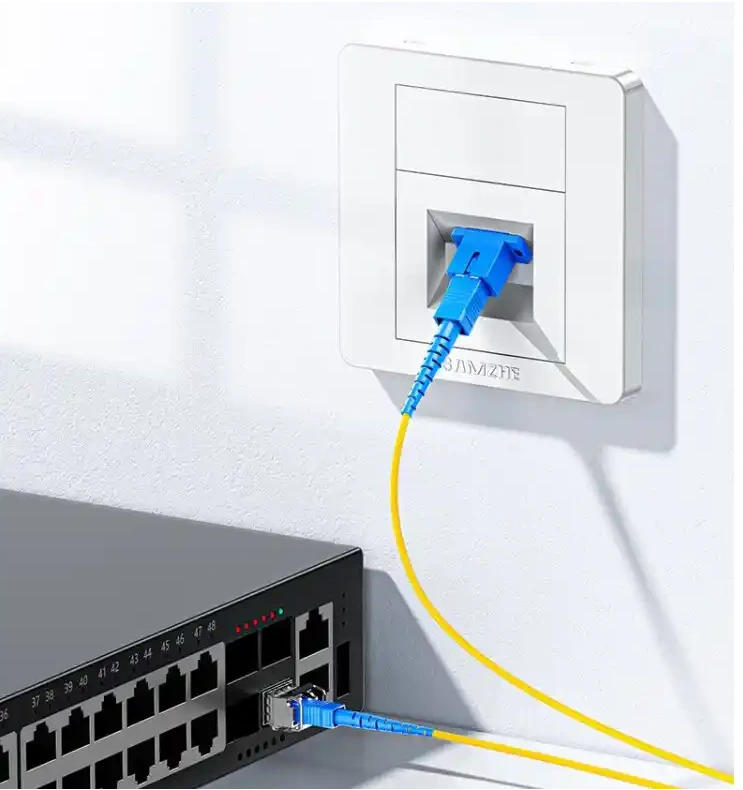
A fiber optic outlet box is a wall-mounted device used for termination and management of optical fibers inside houses or buildings. Located near users’ workstations or home gateways, it serves as a physical link between drop fiber cables and patch cords of terminal equipment.
Besides mere mechanical enclosure, it performs the function of an organized management center that protects optical glass from human actions, dust, and mechanical stress.
A well-designed fiber optic outlet box typically accommodates:
- Input cables: Drop cables of 2.0mm x 3.0mm, 2.0mm round indoor cables, or soft drop cables.
- Protection from splices: Heat-shrink protective sleeves (40mm or 60mm), or mechanical fast connector systems.
- Adapters: Single or dual SC, LC, or FC adapters with ceramic aligning sleeves.
- Slack handling: Built-in routing channels and radius limiters providing a rigid minimum bend radius of 30mm.
How Does a Fiber Optic Outlet Box Work?
The principal objective of a fiber optic outlet box is to protect glass fibers against physical strain and provide stable transmission of signals at the same time. It converts stiff outdoor distribution fibers into flexible patch points for easy access by users.
The connection procedure performed in the device takes place in four steps:
- Cable Ingress and Fixation: Incoming drop cables enter through a rubber grommet at the bottom or rear panel of the unit.
- Fixation of Strength Members: The outer sheath of the cable is stripped off to reveal inner aramid yarn and central strength members, which are fixed on internal clamping posts with stainless steel fixing screws to resist external pull force up to 50N.
- Fiber Splicing & Fusion: The exposed 250-micron fiber core is spliced via fusion to a factory-terminated 900-micron fiber pigtail.
- Adapter Interface & Patching: The fiber pigtail slides easily into a bulkhead adapter inside the fiber box to enable patch cords to be plugged directly into an Optical Network Terminal (ONT), desktop router, or computer terminal.
What Constitutes a Fiber Optic Outlet Box?
For the convenience of maintenance operations and protection of bare fibers, every top-notch fiber optic outlet box requires some specific mechanisms inside.
Fiber Routing Trays
Flip trays or double trays with hinges isolate the distribution tubes from the spliced fiber pigtails to ensure that the insertion losses for all used channels do not exceed 0.2dB.
Adapter Holding Panels
Snap-in molded slots retain SC simplex or LC duplex adapters securely to prevent them from wobbling and causing any other damage while being plugged or unplugged by field technicians and users.
Splice Sleeve Holders
Grooves in plastic or elastomeric combs retain 40mm or 60mm splice sleeves. This arrangement protects delicate glass fusion joints from micro-vibrations, torsional stress, or accidental impact during installer handling.
How Do Fibers Get Organized in the Fiber Optic Outlet Box?
Fiber mishandling results in serious macro-bending loss, micro-bending stress, and unpredictable network failures. In a well-designed fiber optic outlet box, excess fiber lengths wind nicely around special curved guide rails.
Optimal internal organization offers obvious benefits:
- Splice Protection: Isolates naked glass splices from any external pulling tensions and bending stress.
- Organized Layout: Prevents any tangling of loose fibers in the wall-mounted box for quick inspections.
- Loss Control: Ensures adherence to the minimum bend radius (no less than 30mm) necessary to avoid optical attenuation of over 0.35dB/km at 1310nm wavelength and 0.22dB/km at 1550nm wavelength.
- Quick Maintenance: Facilitates troubleshooting, optical power measurement, and OTDR traces for regular network checks on the ports.
In case of multi-dwelling units or large distribution nodes where higher numbers of ports and passive optical splitters are needed, engineers tend to go beyond single-port wall boxes and opt for more advanced distribution solutions like the OMC Group 24-core FTTH ODP box. This reliable equipment provides multi-layer routing capacity and miniature optical splitter trays.
Applications of Fiber Optic Outlet Boxes
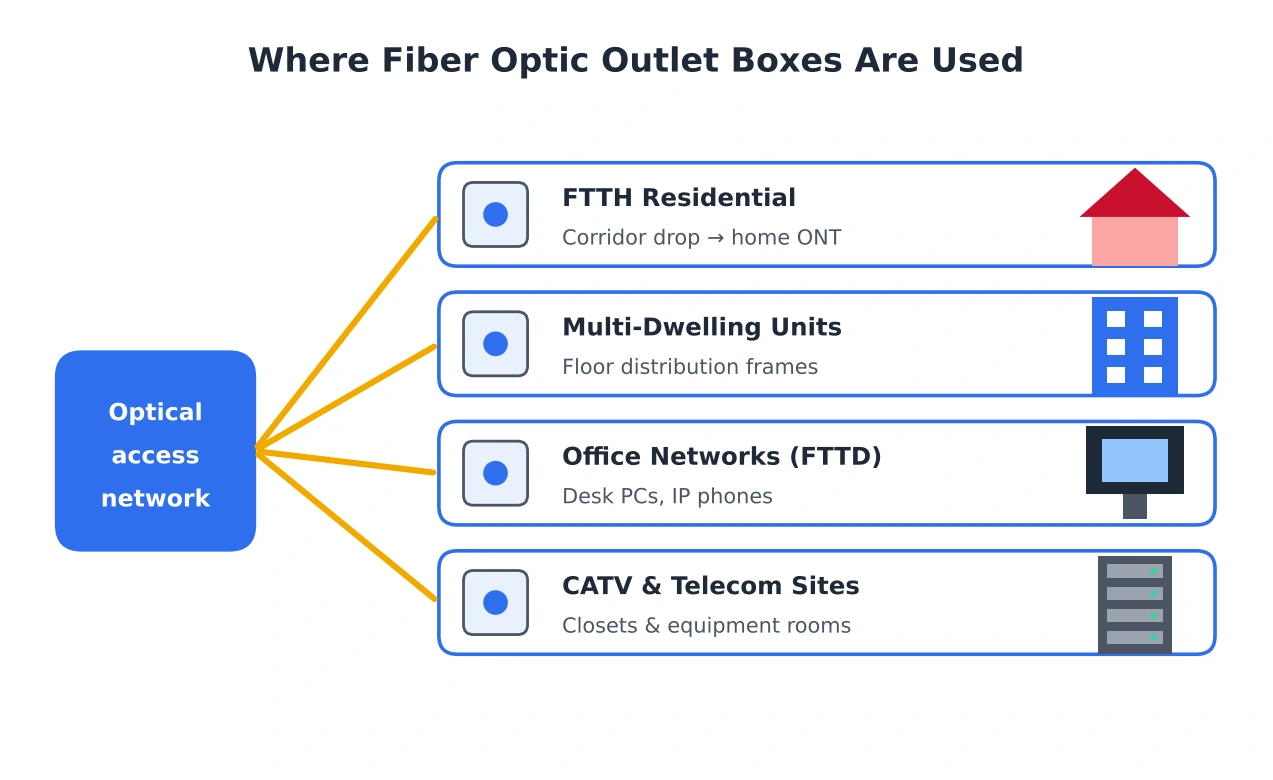
These indoor fiber optic outlet boxes are used in different optical access systems where optical fibers need to connect to their corresponding end-user equipment.
FTTH Residential Buildings
The last optical termination point that will connect corridor drop cables to household ONTs and broadband gateways.
Residential Multi-Dwelling Units
Organizing individual fibers coming from floor distribution frames in multi-dwelling units.
Office Networks (FTTD)
Connecting directly to workstation computers, IP phones, or conference room multimedia devices through high-speed Fiber to the Desk connections.
CATV & Telecom Sites
Compact fiber transition box for commercial telecom closets and institutional equipment rooms.
How Do You Choose a Fiber Optic Outlet Box?
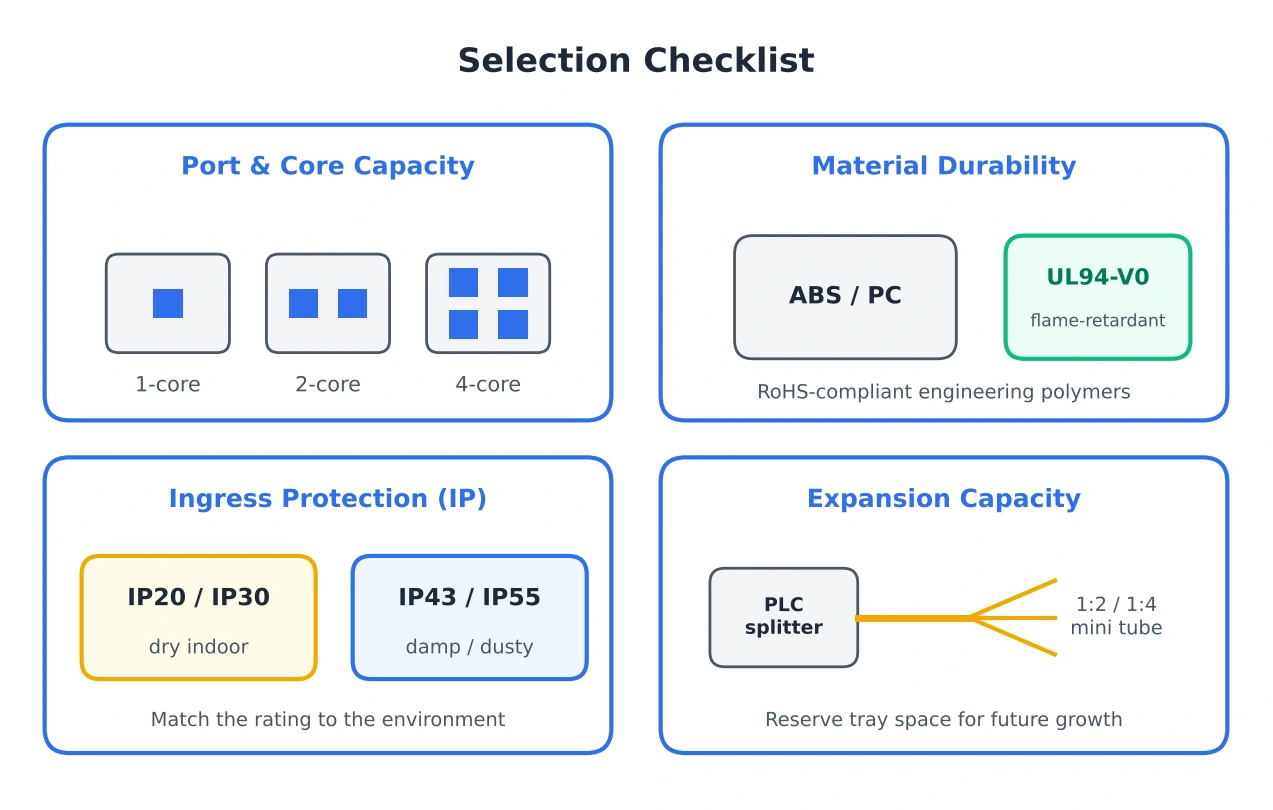
Choosing the appropriate fiber optic outlet box saves you installation time and cuts down labor and operating costs. Important specifications to consider before purchasing one include:
Port & Core Capacity
Selecting the right specification according to the port and core capacity of your network, whether 1-core, 2-core, or 4-core.
Material Durability
Choose boxes that are made from flame-retardant ABS, PC, or RoHS-compliant engineering polymers meeting UL94-V0 flammability requirements.
Ingress Protection (IP Rating)
For the dry indoor setting, choose either the IP20/IP30 series; in cases of a damp basement and dust-prone surroundings, go for IP43/IP55.
Expansion Capacity
Look into the possibility of adding mini steel-tube PLC splitters (1:2 or 1:4) due to the availability of tray space inside for future expansion of the passive optical network.
Conclusion
A properly designed fiber optic outlet box goes beyond being a mere plastic wall plate; it serves as a crucial protector to ensure optical signal stability in FTTH networks. It is very important to know about its configuration and cable management system, together with the key performance parameters of the device.
Do you have any concerns about the design of the fiber optic outlet box? Don’t hesitate to call OMC Group anytime!