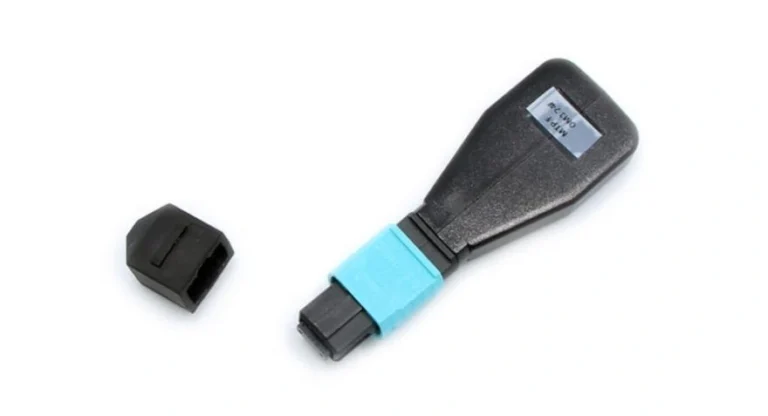
Today’s fast-moving data centers, cloud networking architectures, and enterprise core networks rely on MPO/MTP fiber connectivity for delivering transmission speeds such as 40G, 100G, 400G, and 800G. As link density continues to increase, polarity management has become one of the most error-prone aspects of fiber deployment.
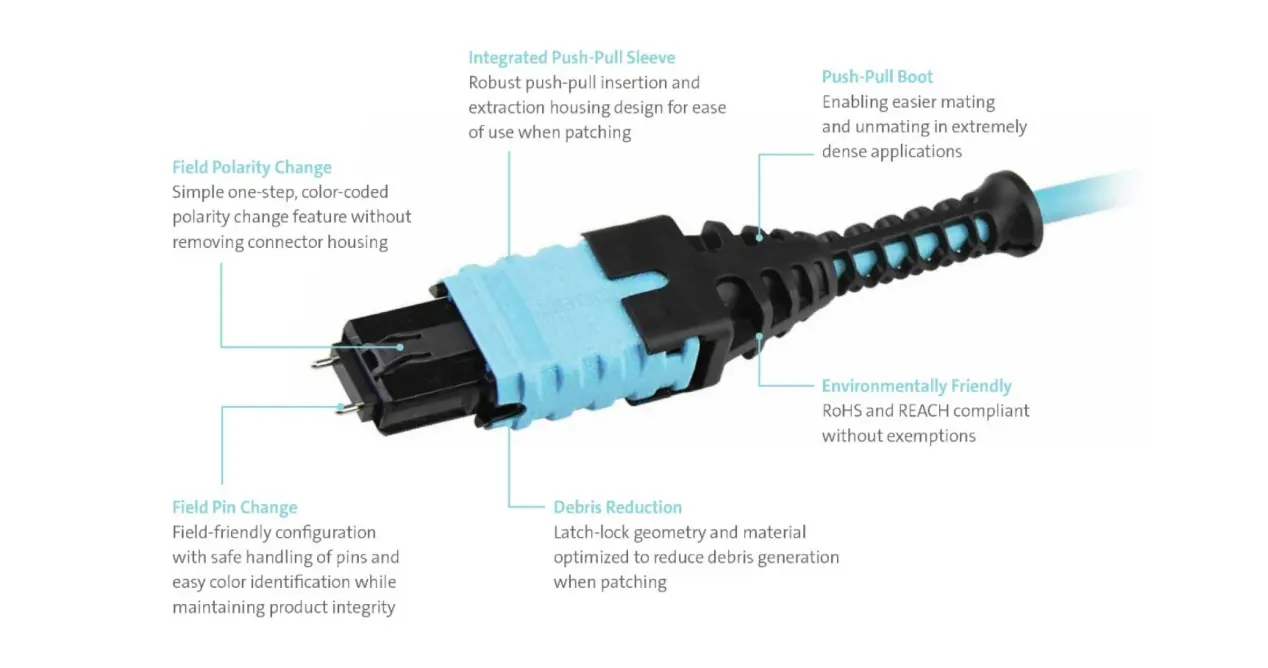
Incorrect polarity setup could cause link failure, communication problems, faulty testing, prolonged troubleshooting, and expensive corrections. Fortunately, the MTP PRO connector offers a more efficient way to handle polarity in such cases. In this article, we look at some potential mistakes concerning MPO/MTP polarity and find out how using an MTP PRO connector avoids those errors.
What Is MPO/MTP Polarity Management?
In fiber optic communication, polarity ensures that the transmitting (Tx) end is correctly connected to the receiving (Rx) end, so that the signal can be transmitted end-to-end in the correct direction.
In MPO/MTP systems, this becomes more complex because a single connector may contain 8, 12, 16, or even 24 fibers. Each fiber must maintain correct mapping across the entire link. If polarity is incorrectly designed or implemented, the system may appear physically connected but fail logically.
Industry defines three standard polarity methods:
Method A (Type A)
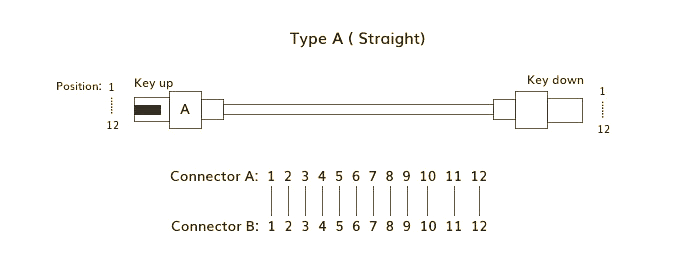
Method A is the most basic straight-through polarity structure. The key feature of it is that fiber placement stays the same throughout the connection path by using the Key-Up to Key-Down approach.
It is relatively easy to create; however, this method lacks flexibility. The modification of the network configuration becomes necessary with any upgrade and topology changes.
Method B (Type B)
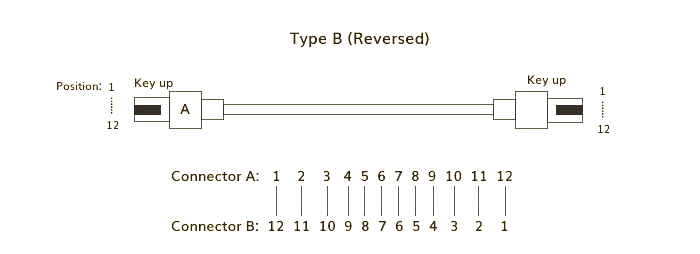
Method B uses a reversed polarity structure, where both ends are Key-Up to Key-Up connections. Fiber positions are fully flipped end-to-end to achieve correct mapping.
This method allows for the simultaneous use of multiple channels and is therefore commonly used in 40G and 100G parallel optical networks. Consistency among all devices is key to preventing possible problems that may be hard to solve.
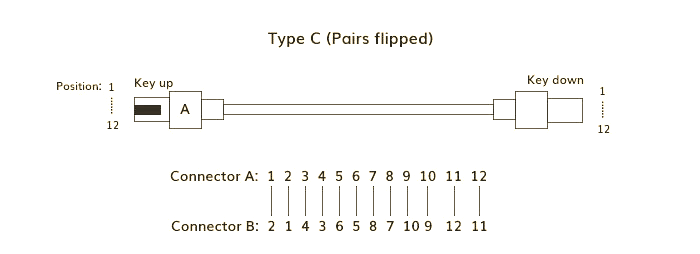
Method C (Type C)
Method C uses pair-wise cross-over within the cable assembly, where adjacent fiber pairs are swapped to ensure correct Tx/Rx alignment.
It is typically used in specific duplex applications and smaller, fixed systems. However, due to its structural complexity and limited scalability, it is less common in high-density parallel optical networks.
If incorrect polarity methods are selected during design or installation, or if different methods are mixed, the entire system may suffer from misaligned optical paths and communication failure.
Common MPO/MTP Polarity Pitfalls
1. Confusing Type A, Type B, and Type C Cabling
One of the most common issues in real-world deployments is inconsistent understanding or incorrect selection of polarity types.
Typical problems include:
- Mixing Type A trunk links with Type B patch cords, breaking overall mapping consistency
- Introducing Type A components into a Type B system, causing a partial polarity mismatch
- Different vendors use inconsistent polarity labeling or definitions
This often results in:
- Physical links appear properly connected
- Optical power tests pass successfully
- But devices fail to establish communication
- Tx signals incorrectly map to Tx instead of Rx
2. Re-cabling Required During Network Upgrades
When upgrading from 10G to 40G, 100G or higher speeds, existing fiber optic architectures are often not reusable, especially in parallel optical environments where polarity alignment is more critical.
Typical upgrade challenges include:
- Replacing patch cords to match new polarity requirements
- Reconfiguring patch panels or module ports
- Replacing or re-routing portions of trunk cabling
These modifications will result in increased costs and greater maintenance periods, and could greatly affect service reliability within environments like finance, cloud computing, and AI that require high availability.
3. Time-Consuming Polarity Troubleshooting
In large-scale data centers, MPO/MTP links can number in the thousands or even tens of thousands. When polarity issues occur, troubleshooting becomes highly complex.
Engineers typically need to:
- Trace fiber paths across multiple link segments
- Verify mapping between patch cords, adapters, and trunk cables
- Use test equipment to validate the signal direction link by link
Due to the distributed nature of cabling, this process is time-consuming and prone to missed or repeated checks, further extending resolution time.
4. Mismatch Between Documentation and Field Installation
In large projects, discrepancies between design documentation and actual installation are very common.
For example:
- Design specifies a Type B polarity structure
- Field installation incorrectly uses Type A components or patch cords
This often results from:
- Multi-team coordination with inconsistent standards
- On-site material substitutions during deployment
- Human installation errors or labeling mistakes
Since these issues may be distributed across multiple points in the network, they are often only discovered during testing or operational phases, making diagnosis more difficult.
How the MTP PRO Connector Solves Polarity Challenges
On-Site Polarity Adjustment
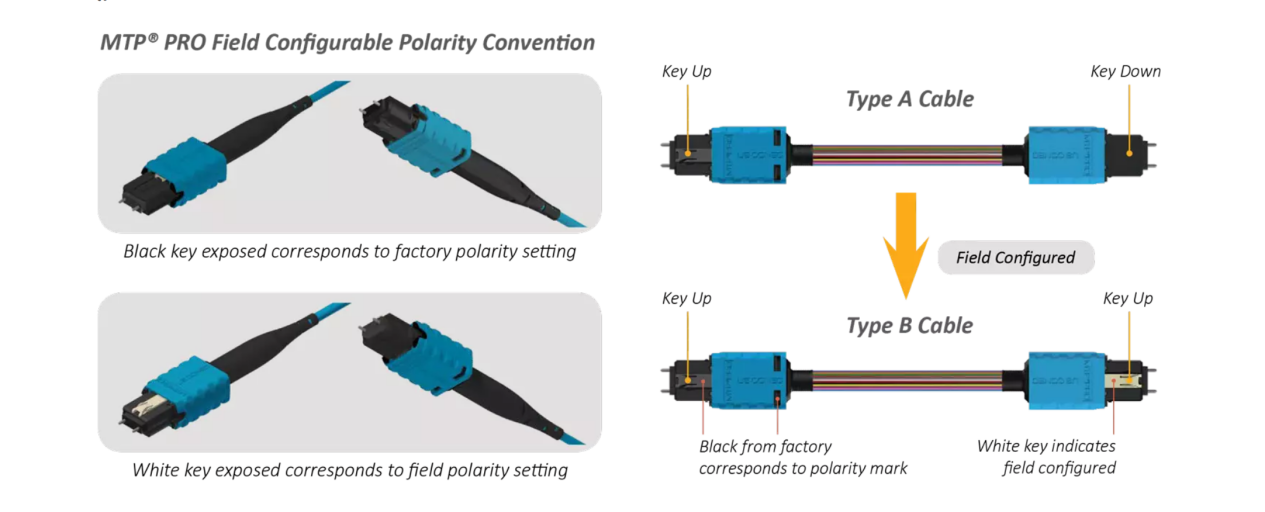
Unlike traditional MPO/MTP connectors, the MTP PRO connector allows polarity adjustments to be made directly in the field, eliminating the need to replace components or re-terminate fibers.
Technicians do not need to:
- Re-splice fiber connections
- Replace entire patch cords
- Dismantle existing cabling infrastructure
This significantly reduces deployment complexity and minimizes downtime risk.
Quick switching between Type A and Type B
During network evolution, different stages may require different polarity configurations, such as transitioning from a Type A design to a Type B parallel optics architecture.
With the MTP PRO connector, it is possible to:
- Quickly convert Type A to Type B
- Easily revert from Type B to Type A
These adjustments can typically be completed within minutes without large-scale cabling replacement, improving long-term network flexibility.
Reduced Inventory Pressure
Traditional MPO/MTP deployments often require separate inventory for different polarity types, including Type A, Type B, and Type C patch cords, which increases SKU complexity.
With the MTP PRO connector:
- One product can support multiple polarity configurations
- No need to maintain multiple dedicated patch cord inventories
- Significant reduction in SKU count and spare part management complexity
This improves supply chain efficiency and reduces overall operational costs.
Lower Rework Costs
Polarity errors are a major cause of fiber rework in data centers. Traditional correction methods often require:
- Reinstalling fiber links
- Replacing incompatible components
- Extended system downtime
With the MTP PRO connector:
- Polarity issues can be corrected on-site
- No need for large-scale re-cabling
- Minimal service interruption
This is especially valuable in high-availability environments where downtime is extremely costly.
Why More Data Centers Choose the MTP PRO Connector
As AI clusters, cloud platforms, and hyperscale data centers continue to grow, network architectures are becoming increasingly complex, requiring higher flexibility and maintainability in fiber systems.
Compared to traditional MPO/MTP solutions, the MTP PRO connector offers:
- Greater polarity management flexibility
- Faster on-site configuration and adjustments
- Lower long-term operational costs
- Higher upgrade and scalability efficiency
As a result, it is increasingly adopted as a key component in modern high-density fiber infrastructure.
Conclusion
The polarity management process between MPO and MTP connectors is among the most crucial and potentially problematic phases in the installation of highly dense fiber optic networks. Misalignment during this phase could negatively affect the functionality of the entire network. Use of the MTP PRO connector makes polarity management easier and reduces operational risks.
As a professional fiber connectivity and data center cabling solution provider, OMC GROUP is committed to delivering high-quality MTP/MPO products and technical support to help build more stable and efficient optical networks. If you need further support on MPO/MTP polarity management or MTP PRO connector selection and deployment, feel free to Contact Us for expert solutions and consultation.