AI servers, cloud computing, and high-speed storage are driving the growth of data processed by data centers. With more widespread use of 100G, 200G, and 400G networks, fiber cabling must have sufficient bandwidth capacity without occupying much space on racks. In a high-density environment, not only the performance of fiber patch cords but also cable management should be taken into account.
A 24F MTP-LC Fiber Patch Cord is meant to serve applications that require multiple fiber channels in one connection. However, to choose the right product, one should pay attention not only to fiber quantity but also to fiber type, optical modules, polarity, insertion loss, and length.

What Is a 24F MTP-LC Fiber Patch Cord?
A 24F MTP-LC Fiber Patch Cord consists of 24 optical fibers and has MTP and LC connectors. An MTP connector is located at one end, and LC connectors are at the other end. The first end is used for connecting many optical fibers together in one connection, while the latter is used for connecting to devices or patching elements with LC interfaces.
If your data center uses MTP connections in trunk cabling, but LC connections are required to connect to the equipment, the use of 24F MTP-LC Fiber Patch Cords is recommended.
The 24-fiber structure allows connecting multiple fiber channels in one compact cable. It is worth mentioning that 24 fibers do not mean that 24 devices are directly connected by the cable. The number of channels that can be used depends on the optical transceiver and network design.
Why Are 24F MTP-LC Fiber Patch Cords Used in Data Centers?
A high-density data center may quickly gather a large number of fiber cables. Multi-fiber connections can help in this case.
Better Use of Rack Space
Compared with installing many individual fiber connections, a multi-fiber MTP system can group multiple channels into one compact connection. This is particularly useful in racks with a large number of optical ports.
Support for High-Speed Networks
Modern data center networks may use 100G, 200G, or 400G optical transceivers. Some of these applications require parallel fiber channels. A 24F MTP-LC Fiber Patch Cord can be used in compatible fiber distribution systems, provided that the cable matches the optical module specifications.
Easier Network Expansion
A structured MTP cabling system can also simplify future expansion. When additional switches or servers are installed, new connections can follow the existing cabling design instead of adding large numbers of separate fiber cables.
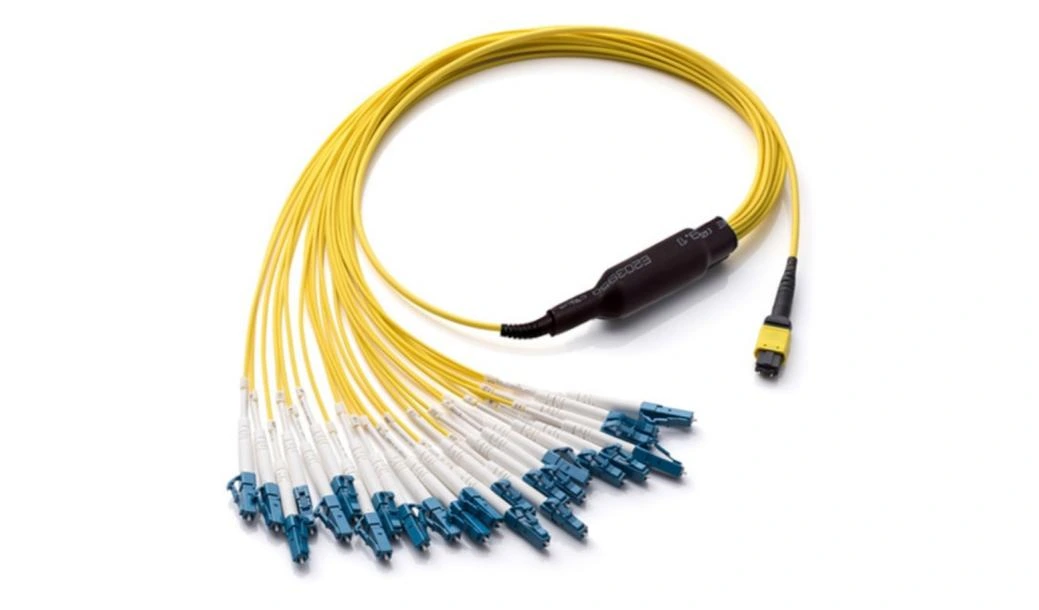
Critical Parameters When Selecting a24F MTP-LC Fiber Patch Cord
Some critical technical parameters should be considered before ordering.
Mode fibre
Firstly, it is necessary to find out what type of fiber is used in the network.
| Type de fibre | Utilisation typique | Main Consideration |
| OM3 | Short-distance data center link | Cost and equipment compatibility |
| OM4 | Higher-speed multimode links | Higher bandwidth and longer reach |
| OS2 | Single-mode networks | Longer-distance transmission |
For instance, the transceiver with a wavelength of 850 nm is expected to use OM3 ou OM4 fibers, whereas single-mode transceivers require OS2 fiber cables. It is always necessary to refer to the optical module datasheet before making cable selections.
Polarité
MTP polarity must match the network design. The transmitting and receiving fibers need to be correctly mapped between the two ends of the link.
An incorrect polarity can cause a connection failure even when the fiber and connectors are otherwise working properly. For this reason, confirm the required polarity and MTP-to-LC fiber mapping before purchasing a 24F MTP-LC Fiber Patch Cord.
Perte d'insertion
Insertion loss (IL) is another important specification for high-speed networks. For example, a connector with a typical insertion loss of 0.35 dB contributes to the total optical loss of the link. When several connectors are used, their losses add together.
The complete optical power budget should be considered rather than looking at the patch cord alone. For critical connections, requesting factory test results can provide a more reliable basis for selection.
Cable Length and Bend Radius
Cable length should match the actual rack layout. A 2 m connection does not necessarily benefit from using a 5 m cable. Excess fiber creates additional slack and can make cable management more difficult.
Manufacturer’s recommendations on minimum bend radius must also be considered during installation. Over-bending may affect the optical performance of the connector.
Frequently Made Mistakes While Selecting 24F MTP-LC Fiber Patch Cord
Selection of a 24F MTP-LC fiber patch cord based on fiber count or cost only may cause difficulties in installing the product. Below, we would like to highlight several common mistakes.
Incorrect fiber selection
Not all fibers, such as OM3, OM4, and OS2, are interchangeable for all applications. Fiber should correspond to the optical transceiver and distance of transmission.
Ignoring MTP polarity
An incorrect polarity or fiber mapping can prevent the link from working even when the connectors are physically compatible. Always confirm the polarity before ordering.
Using the wrong cable length
A cable that is too short can create tension at the connectors, while excessive length adds unnecessary slack inside the rack. Measure the actual routing path before selecting the length.
Looking only at typical insertion loss
The loss of the complete optical link includes connectors, adapters, patch cords, and other components. For high-speed networks, the total optical budget should be checked rather than judging the patch cord by one specification alone.
Skipping end-face inspection
Dust and contamination on MTP or LC connector end faces can affect optical performance. Cleaning and inspecting connectors before installation is a simple step that can prevent avoidable link problems.
24F MTP-LC Fiber Patch Cord Applications in Data Centers
Le 24F MTP-LC Fiber Patch Cord can be used in several high-density cabling scenarios.
Patch Panels and Switches
The MTP side can connect to high-density trunk or modular fiber distribution systems, while the LC side connects to switches or other LC-based equipment. This arrangement can simplify fiber distribution between patching areas and network equipment.
High-Speed Switch Connections
In compatible 100G, 200G, and 400G systems, a multi-fiber connection can enable parallel optical transmissions. The specific details will depend on the transceiver used; therefore, one should always consult the optical module specifications prior to installation. Data Center Expansion
For growing facilities, MTP-based cabling can provide a consistent connection method for new racks and equipment. This will make it easier to deploy more fiber as the network grows.
Conclusion
When selecting the correct24F MTP-LC Fiber Patch Cord, one needs to consider several factors like network hardware, fiber type, transmission distance, polarity, and cable length. Knowing this information before buying will help prevent compatibility problems and additional costs from replacing cables.
If you are designing your new data center or planning to upgrade an existing fiber network infrastructure, do not hesitate to contactez-nous to clarify all your requirements. We will help you determine the proper fiber type, polarity, and cable length.