In fiber optics, bare fibers that have been stripped of the cladding become very fragile. Even small mechanical strain or microparticles can cause microbending losses or even breakage of the fiber. As the most critical physical barrier for spliced joints, selecting the appropriate fiber protection sleeve directly determines long-term network stability and signal transmission quality. In modern times, the single-needle and dual-needle variants dominate the market as the two main varieties of fiber optic protection sleeves.
1. What Are Single-Needle and Dual-Needle Fiber Protection Sleeves?
The fiber protection sleeve is a composite construction made up of three integral parts: an inner adhesive tube (made of EVA or PE), an outer heat-shrinkable high-density polyolefin tube, and some number of internal rods. The distinction between these two is based on the number of internal rods present:
Single-needle fiber sleeve
Comprises only one rod made up of strong stainless steel (or ceramic). It closes all the openings where inner adhesives melt in the process of heat shrinking and prevents the bend axially through this single rod.
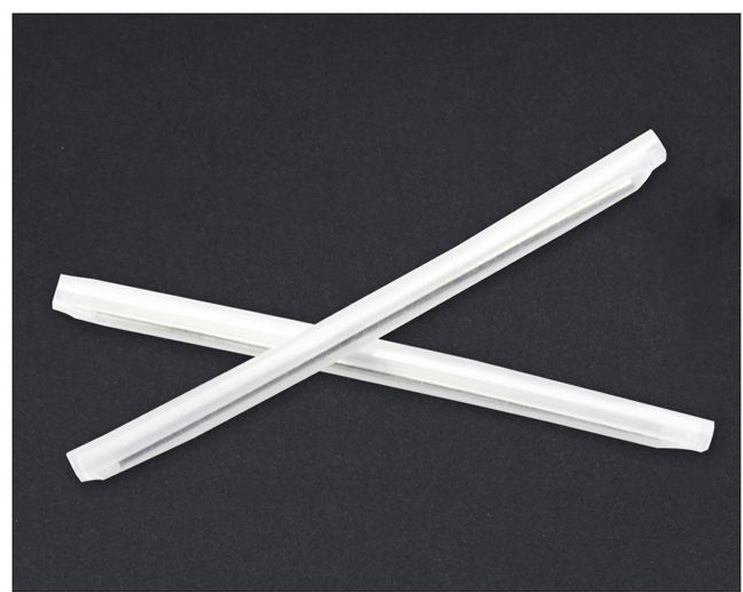
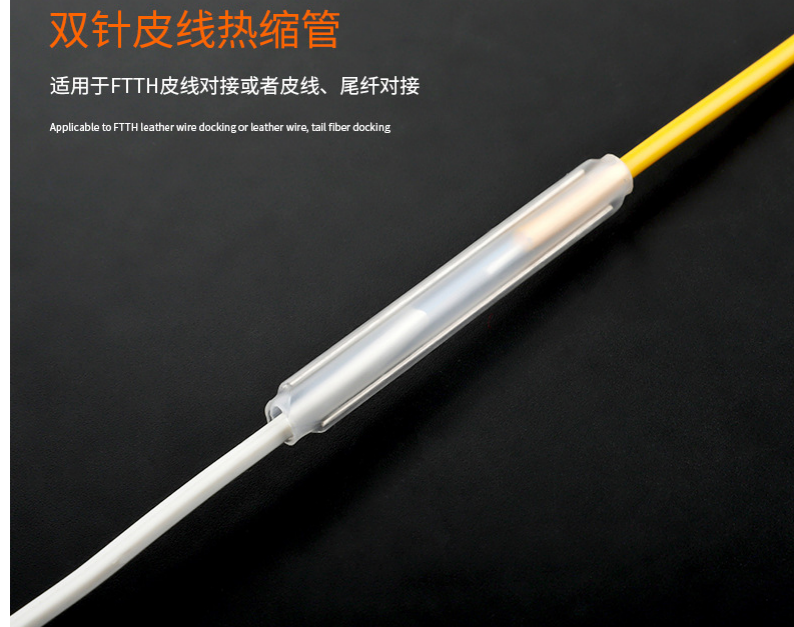
Double-needle
Contains two parallel reinforcing rods (or two special flat quartz/ceramic rods). These two parallel rods create a strong rail plane that evenly distributes all external tensile and twisting forces to both rods.
2. Single-Needle vs. Double-Needle Fiber Protection Sleeves: A Multidimensional Comparison of Key Differences
In order to make an educated decision on the performance of the fiber protection sleeves during field installation, there is a need to assess the following:
2.1 Mechanical Strength and Tensile Strength
Sleeves with single rods employ a single steel rod (typically 1.0 mm to 1.5 mm in diameter) to provide tensile strength of about 10 N to 15 N. Such levels of tensile strength are adequate in static applications such as Optical Distribution Frames (ODFs) or splice closures. On the other hand, the use of two rods in sleeves increases tensile and shear strength by about 50%.
2.2 Attenuation and Microbending Control
Uneven inner adhesive flow during heating can induce microbends in exposed fibers, resulting in added insertion loss where splicing standards usually demand less than 0.02 dB. The double-rod layout fiber protection sleeve maintains a wide, parallel interior cavity that prevents ribbon or multi-fiber strands from overlapping or pinching during shrinkage, delivering superior optical stability.
2.3 Physical Dimensions and Tray Packing Density
Sleeves that have a single rod have an outer diameter that is smaller (usually between 2.4 mm and 3.0 mm after shrinking), thereby taking up less space within a splice tray slot. Sleeves with double rods need a larger profile size (larger than 3.5 mm).
3. Comparison Table of Single-Needle and Double-Needle Fiber Protection Sleeves
The table below outlines technical parameter comparisons between both options, incorporating standard industrial specs from leading manufacturer OMC:
| Parameter Dimension | Standard Single-Rod Sleeve | Industrial Double-Rod Sleeve |
| Strength Rod Count | 1 Rod (SUS304 Stainless Steel) | 2 Rods (Parallel Steel/Quartz) |
| Common Length Specs | 40 mm, 45 mm, 60 mm | 32 mm, 28 mm, 60 mm |
| Post-Shrink Outer Diameter | 2.4 mm – 2.8 mm | 2.9 mm – 3.1 mm |
| Shrink Temperature Range | 90°C – 120°C | 100°C – 130°C |
| Temperatura de funcionamiento | -45°C – +100°C | -45°C – +105°C |
| Typical Tensile Strength | ≥ 12 N | ≥ 25 N |
| Primary Fiber Target | 125 μm Coated Single Fiber, FTTH | Ribbon Fiber (4/8/12 cores), Outdoor Cable |
4. Selection Decision Guide: Which One Should You Actually Choose?
Selecting the ideal fiber protection sleeve comes down to balancing installation environment, mechanical stress, fiber counts, and tray packing density. Rather than treating all network builds the same, evaluating your network setup against these common deployment scenarios will help you make the right choice:
4.1 FTTH Indoor and Standard Distribution Networks (Single-Rod Recommended)
For fiber-to-the-home (FTTH) access networks, enterprise ODFs, and indoor LAN installations, cables remain largely static after splice completion. In these setups, a single-rod fiber protection sleeve offers reliable protection while keeping sleeve outer diameters small enough to maximize tray capacity. A typical option for standard single-fiber setups is el OMC Single Fiber Heat Shrink Splice Sleeve – Transparent:
- Single-Holed Pre-Shrunk Ends: Prevents improper fiber threading during fast field assembly.
- Smooth 304 Stainless Steel Rod: Features rounded ends to eliminate the risk of fiber scoring or cutting.
- Extended Inner Liner: Prevents direct glass contact with the steel backbone.
- Clear Outer Tubing: High transparency permits easy splice centering and visual inspection before and after heating.
4.2 Ribbon Fiber and Mass Fusion Splicing (Double-Rod Recommended)
High-density interconnects in modern data centers and backbone trunk lines frequently rely on 4-core, 8-core, or 12-core ribbon fibers. Because ribbon arrays sit flat, standard single-rod designs cannot provide balanced lateral support, increasing the risk of ribbon twisting or pinching. In these mass fusion setups, a wide-chamber double-rod fiber protection sleeve ensures flat alignment during heat shrink. A standard choice for this application is the OMC 4-12 Ribbon Fibers Heatshrink Splice Sleeve:
- Cross-Linked Clear Cover: High-transparency polyolefin outer layer reconstructs the fiber coating and enables easy visibility.
- Half-Ceramic Strength Member: Features a flat 1/2 ceramic rod that supplies rigid support and prevents bending across the fusion area.
- Hot Fusion Liner: Encapsulates the splice point completely to maintain optimal optical performance and environmental protection.
4.3 Harsh Outdoor and High-Vibration Environments (Reinforced Double-Rod Recommended)
Aerial cables subjected to heavy wind loading and underground enclosures laid along high-speed rail lines experience constant micro-vibrations and thermal expansion. In these harsh environments, a reinforced double-rod fiber protection sleeve delivers heavy-duty protection:
- Dual-Steel Reinforcement: Houses parallel steel rods engineered to absorb severe external mechanical impacts.
- Zero-Stress Transfer: Prevents vibration, shear forces, and physical shock from transferring directly to the delicate splice joint.
- Long-Term Joint Integrity: Locks internal fiber geometry in place to ensure zero failure rates over years of field operation.
5. Conclusion
In terms of fiber protection sleeves, both the single rod and the double rod have their own strengths. The single rod is still the mainstay of global FTTH deployment programs owing to its compactness and cost-effectiveness. On the other hand, the double rod provides better mechanical stiffness and flatness necessary for ribbon fibers. Evaluating your fiber architecture, tray dimensions, environmental stresses, and project budget will point you toward the right fiber protection sleeves for your deployment.
Selection of proper splice protection components is essential for creating a robust optical network infrastructure. If you require any guidance on fiber protection sleeve dimension selection, feel free to contact OMC now!